“buddhism” or “dharma”: what to call it?

I’ve never liked the word “buddhism.” “Isms” tend to be belief systems; “buddhism” is not concerned with beliefs, even understands them as, ultimately, obstacles. Worse still, the word tends to perpetuate the false idea that buddhist practice has something to do with the worship of a man, the historical figure of Siddhartha Gautama.

The alternative approach, which many buddhists adopt, is simply to speak of “the dharma,” an inherently non-sectarian word. “Dharma” simply means something like “the way it is” or “the nature of reality.” It is a much bigger and deeper term than “buddhism,” which is historically and culturally bound. Perhaps we could say that buddhist teachings expound upon and embody dharma in an exceptionally comprehensive way, but dharma is everywhere and ultimately quite independent of buddhism as a concept. Within buddhism, one isn’t trying to become a buddhist but rather a buddha, a fully realized, fully awake being, having completely perfected both wisdom and compassionate skillful means.

So the benefit of using the word is that we can speak of dharmic qualities in people, practices, art, understanding, institutions, businesses etc. that have nothing to do with the narrower entity of buddhism.

The downside is that if the person reading that word is not aware of what it means or how it is being used, it may come across in a manner diametrically opposed to what is intended. I occasionally have used it and then immediately realized that the person I was speaking to must’ve understood it in the same kind of sense I hear phrases like “the Gospel” or “the Word of the Lord” or “the Truth.” In another words, as a sectarian word bound to a particular tradition.

So it’s a dilemma I haven’t worked my way through yet. At the moment I suppose I feel that, as a term for general use, “dharma” doesn’t tend to work so well, unfortunately. So I use “buddhism” (faithful to its Sanskrit and Pali origin, languages with no upper-case letters), and hope that its lower-casedness conveys some kind of distinction at least. (“The tao” versus “taoism” involves exactly the same issue.)

treat yourself…

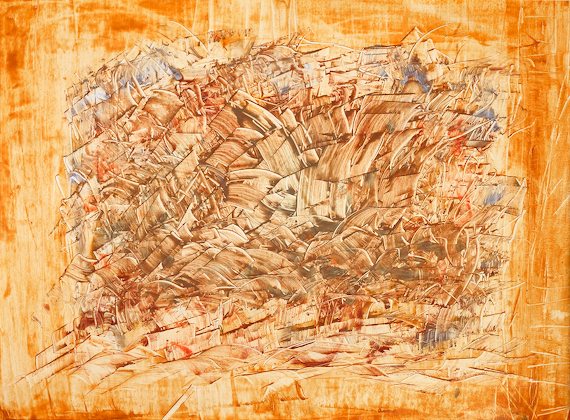
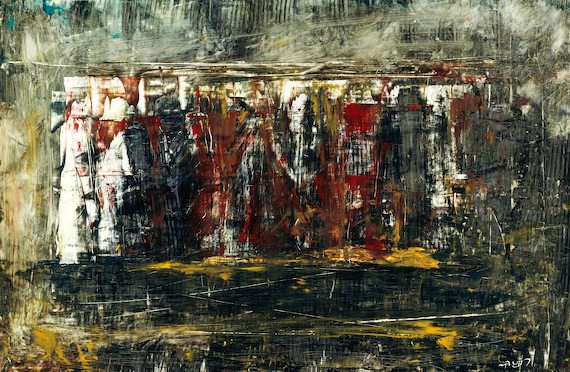
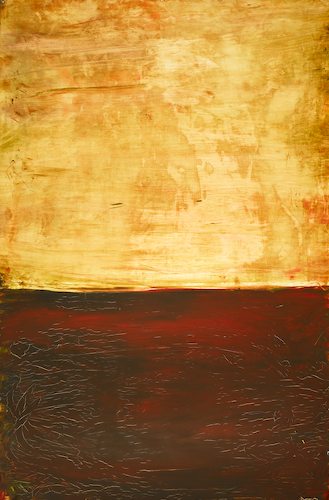
…to a glimpse of some work of Dzigar Kongtrul Rinpoche’s (who goes by the name Kongtrul Jigme Namgyel when he paints). His day job is a Tibetan lama in the Dzogchen tradition with thousands of students all over the world. And then he just happened to take up painting one day… Here are a few more that he’s done. Also here.

Meeting reality directly requires confidence in the fundamentally positive nature of our being. The more we trust what arises in our mind to come from this creative source, the more we can let the mind be as it is, rather than approach it with judgment, fear or manipulation based on our likes and dislikes. My hope is that my paintings communicate the beauty of this unhindered practice of free expression.

I attended a weekend program with him some time ago in Brighton, England but haven’t connected with him since, although he has a center within the state and usually visits each year. I appreciated his distinctively spacious style of teaching. And his ever-astonishing paintings, I find, one after another, stop the conceptual mind cold, startling it into really seeing. Reminding it of how to see, of the big view beyond any manipulation and rejection.

In each moment of awareness we encounter impressions of the outer world through our sense perceptions as well as our inner world of thoughts, feelings and emotions. When we are able to let this incredible array of experience be, without trying to reject what we fear or pull in what we are attracted to—when we relax into experience without trying to manipulate it in any way—we have a complete experience of mind, naked and unaltered. Painting, when it is free of such notions as beauty and ugliness or should and shouldn’t, can be used to express this complete experience of mind. When art evolves from this understanding it provides the possibility for those who see it to also experience the unfabricated nature of their own mind.

I wish to urge students of the dharma who may have forsaken their creative impulse in favor of practice to realize there is no conflict between creativity and meditation. Creativity can be understood, in essence, to be the practice of our own nature and that nature’s expression. You may find your way in to the nature through creativity; or you may come out from the nature to express creativity. Both have to be appreciated as the best of our mind’s potential.

This reminds me of something I was told Trungpa Rinpoche once said: that his teachings on “dharma art,” properly understood, were the highest teachings he had to offer.

The role of the artist is to stop creating and allow experience to unfold in a natural way – creative energy is innate and spontaneously present.

Žižek 2

More generally, Žižek does seem quite taken with possibilities for a redemptive use of violence (see for example this essay by Adam Kirsch – I’m aware that his supporters find this piece a hatchet job, but haven’t (yet) seen anything that convinces me it is not at least on the right track).

Simon Critchley’s thoughts on the same subject – Žižek and violence – are also worth reading.

The title of Žižek’s talk this time is “Buddhism Naturalized,” which makes me even more hesitant to attend. For some years now he has been attacking buddhism in ways that suggest he has little understanding of it. Many have demonstrated this already. Here’s an example of where he’s coming from, in the same interview just quoted from:

Buddhism is the predominant ideology in the west now. It plays a very conformist function. It makes you feel good in global capitalism. I read an analysis why all the top managers in the US like to practice Zen and all. Because things are so confusing now with one speculation you can lose billions of dollars in a minute. The only thing that can explain this is Buddhism which says that everything is an appearance and be aware of the inner reality and all that. You are dealing with just fake appearance. The tradition[al] European thinking doesn’t help in explaining the world in a flux. This new age Buddhism gives authenticity to global capitalism. That’s why Dalai Lama is popular in Hollywood. I hope he is aware of what kind of game he is playing there, maybe he is not aware. He is providing them a cheap spiritual path so that you can basically go on with your life — seducing, sex orgies, drugs, earn money — but it gives you a feeling that I am aware I am not really that. It helps you to normalize and neutralize the schizophrenia we live in.

There are soooo many things wrong and even bizarre about his understanding here that it would take something probably essay-length to do justice to it. So I have to decide whether or not I want to listen to two hours along those lines, maybe in the end asking a question which … probably wouldn’t be engaged with. Basically – grinding my teeth!

Do I really want to see Žižek (especially on buddhism)?

He’s coming to my university with great fanfare but…

Here’s the thing. Though it gives me philistine, unhip status amongst a lot of people, I have yet to understand what is so special about the guy. Admittedly, I don’t know his work well. Have not read The Parallax View, in fact have read only one book of his (the slim Welcome to the Desert of the Real), which did not impress me. Beyond this I’ve read a number of shorter pieces of his and interviews with him, watched a bunch of videos, and eventually … gave up. Not permanently, but I don’t leap to read anything from him at this point.

What I find is that his style tires me, especially the obvious glee he takes in inverting language to create provocation and shock. (And I’m guessing he also relishes the moniker that now follows him wherever he goes: “the most dangerous philosopher in the West.”) Here is a now-well-known example from an India Times interview with Shobhan Saxena (but he does this kind of thing constantly):

Žižek: …what people perceive as violence is the direct subjective violence. It’s crucial to see violence which has to be done repeatedly to keep the things the way they are. I am not just talking about structural violence, symbolic violence, violence in language, etc. In that sense Gandhi was more violent than Hitler. Hitler killed millions of people. It was more reactive killing. Hitler was active all the time not to change things but to prevent change.

Saxena: A lot of people will find it ridiculous to even imagine that Gandhi was more violent than Hitler? Are you serious when you say that…

Žižek: Yes he was, although Gandhi didn’t support killing. With his actions — boycott and all that — he helped the British imperialists to stay in India longer. This is something Hitler never wanted. Gandhi didn’t do anything to stop the functioning of the British empire or the way it functioned here. You have to think why was India called the jewel of the empire? That for me is a problem. Let us locate violence properly.

I hardly know where to begin to respond to something like this. And the trouble is that he engages in this tactic all the time. Here’s another example, from the film Zizek!. The first minute or so of this clip I follow what he is saying but then here is how he ends:

I was always disgusted with this notion of “I love the world,” “universal love.” I don’t like the world. I don’t know how I — basically I’m somewhere in-between “I hate the world” or “I’m indifferent towards it.” But the whole of reality: it’s just it, it’s stupid. It’s out there, I don’t care about it. Love for me is an extremely violent act. Love is not “I love you all.” Love means: I pick out something and I, and it’s, you know it’s again this structure of imbalance. Even if this something is just a small detail, a fragile individual person, I say “I love you more than anything else.” In this quite formal sense, love is evil.

So, I look at this and begin to respond but end up just kind of internally spluttering… I’m not even sure it’s worth it. What I sense in him, perhaps unfairly (and I remain open to seeing it in a different way), is someone really in love with the play of conceptualization for its own sake, so in love that I’m not sure he knows when to stop. And doesn’t seem to understand that now more than ever, when the entire world can read your thoughts via a mere tap on a screen, the philosopher bears even greater responsibility for how they express things, in addition to what is being expressed.

More later.

Bai Hao and Prokofiev

Taking a break from piano practice to drink some always delicious Bai Hao tea from Stone Leaf in Middlebury. With the change in season I find myself drinking less green tea (Bi Luo Chun being a great discovery this past year) and old standby Bao Chung (a green-tea-like oolong), and moving to darker oolongs and black teas like the Yunnan Golden Strand. John’s Bai Hao comes from near the northern tip of Taiwan and is a tea famous for its intriguing honey tones. It hits the spot on this early autumn day. (However, I have just run out and must replenish…)

Have been learning the Prokofiev 9th Sonata, his last. Often overlooked in favor of the previous group of “War Sonatas,” it lacks their density and firepower. The 1st movement, which is the one I’m currently working on, is mostly quite serene, with airy textures and a child-like simplicity in places. The sweet opening theme even makes me think of a music box tune (but not in a bad sense at all).

When I first started playing it I couldn’t quite see it as a whole. It’s unhurried and a little rhapsodic (also oddly spare in dynamic markings). Takes a bit of digging beneath the surface to discover some of the more interesting features. For example, the phrasing is worth a closer look: as my teacher pointed out, it’s quite delicate and precise and a clue to making larger decisions about the piece. And then the other day I noticed just how extended the left-hand chromatic counterpoint in the opening theme is. He really stretches that phrase as far as it will go, and it contrasts nicely with the pure diatonicism of the melody above.

“operationalization?”

So I just received back some comments on a project proposal that contained this word “operationalization.” And it occurred to me that I actually have no idea what this means!

Breaking it apart, 1) we have a root, “opus/opera,” meaning “work” (same as in the musical terms).

And now a whole string of derivational suffixes:

2) the noun “opus/opera” becomes the verb “operate”;

3) which becomes another noun, “operation”;

4) which gets turned into an adjectival form, “operational”;

5) from which we get another verb, “operationalize”;

6) which finally gives us … yet another nominal form, “operationalization.”

That’s 3 nouns, 2 verbs, and an adjective, if anyone is keeping count.

So the question is: how do we simplify this thing? “The procedure whereby something is made operational/workable/usable?” I guess that’s what it’s trying to convey.

But even more fully parsed: “The procedure whereby something is put into a form which can serve as an entity upon which one can do some kind of work.”

Ugh. That’s just one ugly word, isn’t it?

The contextual phrase was “operationalization of theories,” so why not just something like: applying the theories? That’s about half the number of syllables plus pretty much anyone can understand it.

But … that seems to be the point. Non-academic folk aren’t supposed to understand academic-speak anymore. Not just when specialized terms do need to be used, but, like, ever, it seems…

more on this – an extraordinary documentary

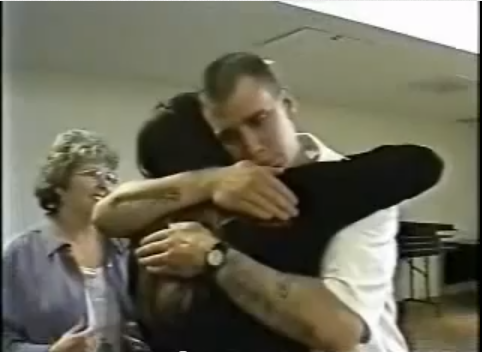
Many people can connect with a restorative approach when the hurt or harm involved is quite minor. In the context of really horrific events, most of us will shut down instantly to even the possibility of this. That’s why the documentary mentioned in the previous post is so powerful. Who could even imagine the scene near the end of the film, in which the mother and daughter of a woman raped and murdered at the age of 26 hug Gary Brown, one of the two men responsible? Who could believe the picture below even possible?

It sounds simply crazy, doesn’t it? Why would Ami White, who was five years old when she lost her mother, Cathy, want to ever lay eyes on either of the men responsible for her death? Why would Linda White, Cathy’s mother? The story is told here, and some testimony Linda gave to the House Judiciary Committee in 2009 is here [currently unavailable, it seems]. The documentary, again, is here, in four parts (about 45 minutes).

For many in a similar position, of course, there is no desire to have any connection at all. But for some there are lingering questions, and for some a connection to the perpetrators of the violence is felt to be a necessary part of healing. They feel a need to communicate to the other person something of the quality and depth of their grief, and to feel that they have truly been heard. They may also have a curiosity about the perpetrator: What drove them to do what they did? Where did it come from? They hope that some kind of more human understanding may help the process of living with almost unbearable loss.

The preparation for this kind of meeting takes a long time, needless to say. This particular meeting took place 15 years after the murder and involved over a year of work I think to bring about – many meetings on each side with the really wonderful facilitator, Ellen Halbert, who is the one in the picture below. The first stage of contact was an exchange of letters, and only some time after this was an actual meeting arranged. The courage of Ami and Linda White that comes out of this film, and also the compassion, is just extraordinary. (Interestingly, Ellen Halbert also came to this kind of work in part out of a violent experience in her own life: she had been raped, stabbed four times, and left for dead in her own home by an intruder.)

Another day later and I’m still demolished by this film, finding it hard to focus on much else. One of the things the Whites discovered when they began to participate in the program was the nature of Gary Brown’s life. His childhood was extremely abusive and he was taking all kinds of substances, including heroin and cocaine, by the age of eight, the year, also, of his first (of ten) suicide attempts… As the prison warden says at one point in the film, looking through Gary’s records: this kid never had a chance. And one of the most beautiful moments in the documentary is hearing Ami in voiceover sympathize with his life over the past 15 years, in prison, as we watch scenes of that life.

Obviously this kind of process is not going to work all the time. But if this could be achieved even in such a horrific set of circumstances, imagine how much more we could do across the board if we wanted to.

empathy is not a zero-sum game

I think part of the difficulty people have in letting go of the urge to punish is the notion that somehow any amount of genuine empathy we extend towards someone who has brought about harm is given at the expense of a recipient of that harm.

And going further: that the more unleashed our hatred of the perpetrator, the greater the love we must really have for the victim. You can see this clearly in the phenomenon of people who cheer at public executions.

I honestly feel the reverse of this to be the case. It seems unarguable to me that the deeper and more fearlessly we can go in trying to understand how terrible actions come to be committed, the deeper our empathy for the direct recipients of those actions too.

A documentary I saw yesterday (in gratitude to Newcomb for introducing me to it) highlights this idea in an almost unbearably moving way. It’s close to unwatchable in the horror and pain that is its subject, but for any who can I highly recommend it. (Just don’t plan on being able to focus on anything else for the remainder of the day…) It’s in several parts, the whole thing being about 45 minutes.)

More in other posts.

restorative practices and compassion

I’ve been thinking for awhile that the restorative practices movement (sometimes called restorative justice, though I think the former has become a more inclusive term) is one of the most progressive and amazing things going on out there. Those who work in the field rightly point to all sorts of problematic aspects with the retributive system we have and more generally the impulse to punish. And they demonstrate all kinds of real benefits to the restorative approach.

There’s a lot to say about this. For now I only want to mention one connection that doesn’t seem to get talked about enough. And this is that from the standpoint of radical interdependence, the understanding that every thought, word, deed, phenomenon comes out of an ultimately illimitable mesh of “causes and conditions,” ie that such a mesh is inescapably coextensive with the mesh that is the universe itself, no other basic approach to reparation or justice can be considered truly compassionate.

When we stop condemning/scapegoating some people as simply “Bad”/”Evil” because simply too much of what they have experienced in their life has led them in certain harmful directions, we are left with the far more difficult task of trying to see those paths more clearly. And that, surely, is the beginning of compassion itself: stepping into the other person’s shoes.

Which, of course, can be extremely hard to do because it dissolves the barriers between “good me” and “bad them.” It forces us to see that, if we were that other person … we would be that other person. That’s a tautology only on the surface. Our “goodness” really does depend on someone else’s “badness.” Both are products of far too many conditions to even begin to hold in our heads at once. A retributive attitude, however understandable in certain circumstances, ultimately doesn’t make sense. I don’t think that in the end we have much of a choice but to keep moving, inch by step by leap, in the direction of love. Into an ever more expansive empathy.

for what it’s worth…

Somehow or other I came across this survey, a series of questions designed to place you with regard to current political party platforms and presidential candidates. I almost never take things like this since I always find many of the questions unanswerable as stated. And in general don’t feel they accomplish much.

But I took this one, sitting around one day. There were 40 questions in 8 categories. A number of these I had to leave blank – most of those in the economic section as I simply don’t know enough to have a view, and a few in the foreign policy section (ditto, or because possible answers were too conditional).

This one seemed slightly different in one respect in that it had an answer for each question called “choose another stance,” which when clicked brought up several other possible responses. Also, part of the question involved ranking your sense of its significance (how the algorithm works for all this is of course always one of the crucial aspects).

I took it twice in fact, the second time trying to answer a few more questions. The first time, my results were as follows. They are listed as a percentage of how much I apparently agree with the views, those asked about anyway (more on this later) of the respective candidates.

Stein (Green Party): 98%
Anderson (Justice): 87% [never even heard of this party…]
Johnson (Libertarian): 62%
Obama (Democrat): 57%
Romney (Republican): 0% [hmm]

The second time I took it, with no more than a few added responses, the results were:

Stein: 94%
Johnson: 75%
Anderson: 73%
Obama: 68%
Romney: 1%

Also, apparently I agree with Vermont voters 51% of the time on these questions and American voters 50% of the time.

Lessons to be learned in a subsequent post. But for now, it’s worth pointing out that, in fact, there are definitely “conservative” (in the deeper, older sense of the word) aspects to my political profile. A preference for slower, organic change, whenever remotely possible. A cherishing of the Constitution. A lack of enthusiasm for identity politics. And plenty of others, none of which, it seems ever get measured by these sorts of surveys.

what health care + unlimited profit cannot help but create

There has been a flurry of good books recently on the state of psychiatry, more specifically on the proliferation of “syndromes” over the past several decades, and the vast increases in people being prescribed drugs for these – including ever larger numbers of children. Marcia Angell had two excellent pieces in The New York Review of Books a year or so ago: “The Epidemic of Mental Illness: Why?” and “The Illusions of Psychiatry”. These reviewed the following: Unhinged: The Trouble with Psychiatry – A Doctor’s Revelations about a Profession in Crisis, by Daniel Carlat; Anatomy of an Epidemic: Magic Bullets, Psychiatric Drugs, and the Astonishing Rise of Mental Illness in America, by Robert Whitaker; and The Emperor’s New Drugs: Exploding the Antidepressant Myth, by Irving Kirsch.

Now comes one of the single best summations of what is terribly wrong with our current system of health: an article in The Guardian by psychiatrist Ben Goldacre called “The Drugs Don’t Work: A Modern Medical Scandal.” It’s long but very worth reading in full.

What Goldacre’s piece is so good at is making clear just how corrupt the process is by which new drugs become approved for sale. For example, most people are not aware that negative test results simply don’t need to be published, and rarely are. Goldacre begins with an experience he’d had prescribing the antidepressant Reboxetine. He’d read the published studies (the results of the trials were “overwhelmingly positive”), talked it over with his patient, and they went ahead. However, two years ago a much bigger picture emerged when researchers were able to locate and collect all the data on this particular drug. It turns out that out of seven trials comparing it to a placebo, only one of these showed a positive result. And this, of course, was published. The other six trials, making use of nearly 10 times the number of patients, showed the drug worked no better than a sugar pill.

These were never published.

The story is the same with studies comparing Reboxetine to other antidepressants. And it’s the same with studies on side effects.

Here is Goldacre’s summary of the current state of affairs:

Drugs are tested by the people who manufacture them, in poorly designed trials, on hopelessly small numbers of weird, unrepresentative patients, and analysed using techniques that are flawed by design, in such a way that they exaggerate the benefits of treatments. Unsurprisingly, these trials tend to produce results that favour the manufacturer. When trials throw up results that companies don’t like, they are perfectly entitled to hide them from doctors and patients, so we only ever see a distorted picture of any drug’s true effects. Regulators see most of the trial data, but only from early on in a drug’s life, and even then they don’t give this data to doctors or patients, or even to other parts of government. This distorted evidence is then communicated and applied in a distorted fashion.

In their 40 years of practice after leaving medical school, doctors hear about what works ad hoc, from sales reps, colleagues and journals. But those colleagues can be in the pay of drug companies – often undisclosed – and the journals are, too. And so are the patient groups. And finally, academic papers, which everyone thinks of as objective, are often covertly planned and written by people who work directly for the companies, without disclosure. Sometimes whole academic journals are owned outright by one drug company. Aside from all this, for several of the most important and enduring problems in medicine, we have no idea what the best treatment is, because it’s not in anyone’s financial interest to conduct any trials at all.

Goldacre includes a disturbing example of a dangerous drug (Rosiglitazone) remaining on the market for years because the system is so flawed. The trouble is: nothing changes in this regard. There has been a record number of fines imposed upon the pharmaceuticals in recent years but even though the amounts seem high to us, they represent a non-constraining fraction of annual profits. So there is simply no incentive to be safer; every incentive to cut corners, spin results, and find new “markets”…

are the Japanese really forgetting how to write kanji correctly?

I found this post on Language Log yesterday rather sad:

According to a recent survey of more than 2,000 people, 66.5 percent of Japanese think they are losing the ability to correctly handwrite kanji. Moreover, the level is above 50% for every age group except for the youngest (16-19), who are of course still actively studying characters and thus must be prepared for tests; and even there the figure is still very close to the 50% mark.

And these figures are much higher than 10 years ago.

The significance of this isn’t completely clear to me as the article (and perhaps the recent survey as well) doesn’t specify the relative number of kanji which are becoming difficult for those that replied in the affirmative. I’d guess all the more frequent characters remain easily writeable. But the long-term trend of writing less and less by hand seems assured, so… I assume there is an increased use of hiragana for less frequent characters. Which, on top of the ever more frequent non-native borrowings into katakana, will make the writing system a stranger hybrid over time.

There’s an interesting post near the bottom of the comments section about the history of Chinese character use within Korean, and the stages by which, over the course of the past century or so, the former has ceded most of its ground to the Hanguel (the native Korean syllabary). Still very hard for me to imagine the same thing happening within Japanese, for several different reasons, but it’s an unusual situation.

hops and grapefruit

At The Farmhouse just now, sampled an especially nice double IPA called Hill Farmstead Society and Solitude #5 (for the name alone…) The first linked review there does it justice I think. There’s no actual grapefruit in it, but it does smell remarkably like. The hops are from New Zealand.

And brewed in Greensboro, home of Caspian Lake, Willey’s Store, and the very special Greensboro Garage. (Strange to contemplate, but the late Chief Justice Rehnquist owned a summer home in the town also.)

It’s only been recently that I started drinking beer again. One of the treats of travel in England when I lived there was sampling the local brew, and I got into continental beers there also — primarily Belgian Trappist Ales. But on returning to the States, for some reason it took awhile to realize just how good and extensive the local beer scene has become in Vermont.

The Farmhouse carries around 20 rotating draught beers, many of them local, and then quite a few dozen more in bottles. It’s an amazingly successful place, always packed, as is the other new(ish) restaurant opened by the same owners, El Cortijo (“The Farmhouse” en español). The latter I’ve come to appreciate since a) it serves genuinely out-of-the-ordinary Mexican-inspired food, with mostly locally sourced ingredients, and four different vegetarian options, all nice and creatively thought-out; b) the menu is flexible, with individual tacos about $4, so you can have as many or as few as you like; and c) it’s open late–till 12 or 1–which is welcome in a town that largely goes to sleep mid-evening.

Sartre on anti-Semitism

Have been reading Sartre’s Anti-Semite and Jew: An Exploration of the Etiology of Hate. Quite brilliant, with a number of very insightful passages. Still digesting it, but appreciating having to think through the dimension of class that he brings in.

Another interesting contribution is the film The Believer, which really … packs a punch. The (Jewish) filmmakers held nothing back in trying to reach the deepest level of pathology that is going on, and a lot of viewers were offended by this. But I think it’s a necessary thing to try and do. One scene stands out for me in this regard: Ryan Gosling (who is amazing in this) in a café with the New York Times reporter, laying out his philosophy. (His character is based upon a real person, a Jewish anti-Semite who became something of a terrorist.) Where Sartre focuses (at least so far, I’m only halfway through) on psychological processes of resentment and scapegoating, that scene takes the film perhaps even deeper, into “blood” and the body and sexuality–the Jew as culturally “effeminizing” force par excellence.

I find contemporary anti-Semitism quite terrifying in its paranoia and hysteria. “Anti-Semitism” isn’t actually a good word for it both because, of course, the Arab people are also Semitic, and because “anti” is far too mild a term to describe the literally deranged rantings one comes across online too often. I don’t know of any phenomenon quite like it. All the more reason that we descend as far as we can, and dare, to try and understand the swamps of confusion and fear out of which it arises.

Seth Mnookin on the current troubling state of science reporting

Seth Mnookin over at PLOS has an excellent piece on the present state of science writing, worth reading in full. Here are some highlights:

Lest anyone think that the ENCODE case was sui generis, just this past Wednesday, a team of researchers based in France published a paper in PLOS ONE titled “Why Most Biomedical Findings Echoed by Newspapers Turn Out to be False: The Case of Attention Deficit Hyperactivity Disorder.” (The paper’s authors were intentionally evoking the title of John P. A. Ioannidis’s groundbreaking 2005 piece, “Why most published research findings are false,” which built off of his earlier JAMA paper, “Contradicted and Initially Stronger Effects in Highly Cited Clinical Research.”) After examining every newspaper report about the ten most covered research papers on ADHD from the 1990s, the authors were able to provide empirical evidence for a troubling phenomenon that seems to be all but baked in to the way our scientific culture operates: We pay lots of attention to things that are almost assuredly not true.

The first cited article above (by Gonon, Konsman, Cohen, and Boraud) examined 47 scientific publications on ADHD from the 1990s, “echoed by 347 newspaper articles.” The authors selected the 10 most echoed publications, tracked all subsequent research relating to them up to 2011, and also followed newspaper coverage of this research. Here were their results:

Seven of these ten publications were initial studies; three were not. Of the seven, “the conclusions in six of them were either refuted or strongly attenuated subsequently. The seventh was not confirmed or refuted, but its main conclusion appears unlikely.” Of the three, one of the findings has been attenuated. (In other words, eight out of ten of these studies, 80%, cannot be confirmed as originally stated, and 60% have already been either refuted or “strongly attenuated.”)

Now, how did newspapers report on all this? “The newspaper coverage of the “top 10” publications (223 articles) was much larger than that of the 67 related studies (57 articles). Moreover, only one of the latter newspaper articles reported that the corresponding “top 10” finding had been attenuated.”

Put another way, newspapers paid pretty much exactly FOUR times as much attention to the original studies–80% of which have either been subsequently refuted or unconfirmable as stated–than to the related studies. And a grand total of one out of 57 articles on the related studies even bothers to mention that the original finding cannot be confirmed as stated!

Why is this the case? Mnookin suggests:

Because it’s sexier to discover something than to show there’s nothing to be discovered, high-impact journals show a marked preference for “initial studies” as opposed to disconfirmations. Unfortunately, as anyone who has ever worked in a research lab knows, initial observations are almost inevitably refuted or heavily attenuated by future studies–and that data tends to get printed in less prestigious journals. Newspapers, meanwhile, give lots of attention to those first, eye-catching results while spilling very little (if any) ink on the ongoing research that shows why people shouldn’t have gotten all hot and bothered in the first place… The result? “[A]n almost complete amnesia in the newspaper coverage of biomedical findings.”

He goes on to summarize: “…publications that should be exemplars of nuanced, high-quality reporting are allowing confused speculation to clutter their pages; researchers and PIOs are nudging reporters towards overblown interpretations; and everything we write about will probably end up being wrong anyway — not that we’ll bother to let you know when the time comes.”

Tirez sur le pianiste

Rewatched it recently and it was like seeing it for the first time. So fresh. They must’ve had some fun back then making movies, the nouvelle vague folk. It shines out of so many scenes in Shoot the Piano Player, a playful, open-ended, we-can-do-anything quality. This one had a lot of improvisation in it, apparently. They didn’t even know what the ending would be until it was time to shoot it.

One of my favorite scenes is near the very beginning. Charlie Kohler (Charles Aznavour), the eponymous piano player, has a brother, Chico, who is being chased by two men (we have no idea why yet). Chico runs into the bar where Charlie plays, to hide. They have a brief exchange but it is time for Charlie to start a new set. Suddenly we are thrown into a hilarious tune (suggestive and somewhat surreal) sung and I think written also by Boby Lapointe (who by that point was fairly well-known in France). The three musicians have fixed and completely contrasting facial expressions throughout the entire sequence–Charlie in hang-dog (Charlie’s in hang-dog the entire film…), Boby Lapointe intense, super-serious, bouncing from foot to foot, and the drummer grinning from ear to ear. For part of the scene you get the faces together in triptych. Brilliant.


I believe the budget for this movie was virtually nothing, but that meant Truffaut and Co. could do whatever they wanted, and it also meant location shooting on the streets in Paris, trusting in intuition, spontaneity. There is farce followed by real pathos and back to farce again, fun from the opening chase scene to that final, unforgettable shot of … (don’t want to give anything away) … rolling down the snow-covered slope.

And then there’s the single most famous image (and justly so). But I won’t try to explain it–you’ll just have to see the movie…

small hours with John Martyn…

It’s nearly 4, reminding me of the John Martyn song “Small Hours”… Over the summer I discovered piles and piles of live videos of him on YouTube going all the way back to the 70s.  And a couple of nice full-length documentaries. A man barely known in the States but nobody else had a voice like him or ever will. No slouch on guitar either but for me it was that tender, growling, roaring, aching, endlessly expressive voice… Simply one of the greatest singers we have had.

I got to see him once. He could give spine-chilling performances live, every one unique, and then he could get on stage totally wrecked and sound a complete mess. I caught one of those gigs, in a small club. He came on swigging scotch the first half, came back for the second chain-smoking spliffs, which he would smoke 3/4 of the way down then toss into the audience. (One of which landed at my feet, then disintegrated…)

He started out as a folkie in the late 60s then incorporated jazz / rock / blues elements in a way all his own, until eventually there was just nobody who sounded like him. Ended up with a burst cyst in his right leg, requiring amputation, after which he also put on a ton of weight. He lived such a wild life a lot of people, including he himself, were surprised he made it as far as he did (we lost him in 2009, to pneumonia). Not a consistent songwriter–there are chunks of his career I don’t connect with, but then there are these moments…

Like the song he wrote for his friend Nick Drake in 1973, the year before Drake died, age 26.

But then, can you believe this is the same guy, only a few years later? A 10,000 volt version of “Lookin’ On” :

Then for something completely different again … I was watching the movie “The Talented Mr. Ripley” one day, shell-shocked by the ending, the film score music going on over the credits, then a pause halfway through and suddenly … that voice again. It was John Martyn of all people doing a cover of the jazz standard “You Don’t Know What Love Is,” but doing it like it’s never been done before, in this sinuous, intimate, world-lost way. Such a brilliant choice by the director Anthony Minghella also (a movie full of brilliant choices and breathtaking ensemble acting by every lead) — the song gives a sort of ambiguous, subversive little twist I think on the movie. Martyn himself said that often a singer has to be satisfied with getting to 7 or 8 out of 10 of what they were after, but that with this recording he felt he hit a 10.

And finally a performance of “One World” from 1990. He doesn’t start singing until almost 3 minutes in but … don’t touch that dial!

A heartbreaking version of “Never Let Me Go” from the same concert is also up on YouTube but cut off a minute or so from the end unfortunately. So you also miss the stunned silence afterwards and some guy in the audience then whispering “beautiful” …

The guy even does … “Over the Rainbow” … like you never heard …

or, as once was said long ago…

The living are soft and yielding;
the dead are rigid and stiff.
Living plants are flexible and tender;
the dead are brittle and dry.

Those who are stiff and rigid
are the disciples of death.
Those who are soft and yielding
are the disciples of life.

The rigid and stiff will be broken.
The soft and yielding will overcome.

Tao Te Ching 76 (J.H. McDonald translation)

Michael Chabon nails it

From an interview published yesterday (my emphases).:

“The men in Chabon’s books all come in pairs … in every possible permutation: fathers and sons, business partners, collaborators, lovers…. These permutations interest him mostly because, in real life, men have so few options for how to relate to one another. ‘It’s your buddy or your business partner or your romantic partner,’ Chabon says. ‘Or your enemy. That’s it. That’s all we’ve got.’

“Chabon envies women’s relatively greater emotional freedom, he says. And he believes that ‘a lot of the things men feel in terms of confusion and frustration and lack of emotional connection and fulfillment is because the accepted possibilities are so paltry.’ With his books, he says, ‘ultimately the question I’m asking is: What does it mean for two men to love each other? Do male friends love each other? And if they do love each other, what kind of love is it? Do they say they love each other? Do they even know they love each other?’

“Chabon does love men. He has written, in his nonfiction, about sleeping with one man and falling in love with another, and although he’s close to many women, he says his mental category of ‘best friend’ is, by default, male. (‘If I were casting the part, I’d call in men.’) But he is profoundly frustrated by how men behave, or rather by how they misbehave, a problem he sums up as ‘dickishness.'”

scientism

Awhile back Philip Kitcher, philosopher at Columbia, published a piece on scientism in The New Republic, leading to a lengthy exchange with Jerry Coyne. I want to reply to this exchange at some point as it’s a question I’ve been contemplating for quite awhile. Though there were good things said in the original article I would have preferred an even more robust defense of the humanities. So when I get the chance I will make an attempt at one.

Along with this, I’m troubled by the basic response Kitcher received. Coyne says: “I’d prefer to see the word ‘scientism’ quietly shelved, replaced by more specific charges like ‘scientists sometimes overreach themselves’ or ‘scientists denigrate the value of literature.’ Those, at least, are charges that can be documented and discussed using evidence. The general charge of ‘scientism,’ slippery of definition, can’t be.”

No no no! I hasten to disagree, strongly. The concept is so very necessary, crucial even. But more on this another time.

“your heart is the big box of paints”

“…and others, the canvas we’re dealt.” (XTC – “Wrapped in Grey”)

Earlier today overheard the tail end of a sentence: “… they’re just so uncomfortable with shades of gray.” But, really, this isn’t right. Shades of gray are still only combinations of black and white. The third category merely buttresses the overarching sovereignty of the Two. Of “This or That.” So now we have “sort of This, or sort of That.”

But I think what we really fear is the profundity and brilliance of living colour. Irreducible to anything else, to any grid or agenda, any … This or That. The redness of red, the blueness of blue, the greenness of green. As the Buddhists say, “suchness” beyond concept. That which is, in itself.

I guess this is why I’ve always liked the term “person of colour.” And, in part, it’s why I’ve always disliked the term “bisexuality,” for instance. Because the latter keeps us imprisoned in one-dimensional calculus: there’s a dot over here, and a dot over there, and you can have one dot, or you can have two dots, but that’s “who you are,” that’s what your longing is, your full exquisitely sensitive aesthetic. It’s a dot — or two.

But our “sexuality” or libidinal universe, the realm of all that we find beautiful as a body among bodies, down to the last unmappable particular — this remains unique to us, vast and uncontainable. Not black, not white, not black-and-white, but our own personal world of brilliant colours.

And so with our pure longings, in our natural radiance, we go out into the worlds which are given to us, and we create our communities of love.  

“your heart is the big box of paints
and others, the canvas we’re dealt
your heart is the big box of paints
just think how the old masters felt, they call:
awaken you dreamers…”