dream fragment

Some contemporary writer (Jonathan Franzen?) has as one of his guidelines for fiction to refrain from bringing in dreams, presumably because he doesn’t feel they are interesting except to the people who dream them. Personally I find a compelling dream as compelling as anything else. In any event I’m about to break that rule (or would be doing so if this post were a piece of fiction), for…

I am in a kitchen, opening the fridge, searching for something to eat. Almost everything I see or open contains carrots and peas in some form or other. I give up for the time being, turn, and start walking out of the room. As I pass the sink I notice some kind of insect moving from the counter down into the sink and thence the drain, and then another. The third one however is blocked from doing so by a very fast-moving critter coming from nowhere, who catches up to the other and sort of taps it, whereupon it crumples. Peering more closely I see that the attacker is … a miniature moose! A moose the size of an insect. I wake up.

Now, as soon as this little vignette ends I’m asking myself, of course: huh? And three sources quickly come to mind, all condensed into that single image.

grasshopper editMost immediately, I am unfortunately in the midst of dealing with an insect situation in my bathroom. The water people uprooted the meter in there, to replace it with something external that can be read remotely, and I think it must have disturbed the local ecology.  It has been a bit of an ordeal for the past week or so, with several different species suddenly appearing out of nowhere to surprise me in the middle of the night…

mulholland drive image editSecondly, I’d just written a post about David Lynch, including my favorite of his films and one of my favorite films of all, Mulholland Drive, which includes a scene – viewers will vividly remember – of an elderly couple suddenly miniaturizing and passing under the door of a room.

mooseAnd thirdly, the moose is an animal one must watch out for on Vermont roads, as running into one is more-or-less like hitting another car head-on. That particular fear is lodged in my unconscious, for sure, and just a couple days ago in the neighborhood where I live a young deer suddenly appeared at the side of the road, about to cross, saw me, stopped, and scurried back into the woods.

So, some neat condensation going on there, it seemed to me.

The carrots and peas?  I’d just bought some in frozen form.  Also, it was the first vegetable combination I learned how to make into a curry…

lentil and zucchini cakes with rice pilav at Mint

Yesterday evening at Mint Restaurant in Waitsfield (Vermont) I had something especially delicious. The photo below unfortunately doesn’t do the colors justice at all as it was an overcast sky: the harissa sauce is much more vivid in reality, a deep, just slightly orangey red; the green sauce (which looked similar to traditional Indian mint chutney but was in fact made of spinach, subtly sweetened with agave) came out a little garish in the automatic flash; and the cakes (lentil, zucchini, onion, and spices) and rice pilav lack a lot of the warm colors of the real thing. But I thought I’d add my photo in any case to give a hint of what the dish looked like. It was wonderful: the cakes and rice pilav each moist and richly flavorful in complementary ways, the harissa adding a lovely, bright heat, the spinach sauce balancing it with its fresh coolness and dab of sweetness.

A starter of butternut squash soup with leeks, coconut cream thyme, pumpkin seeds, and (for flavor, not so much for sweetness) pears, completed the meal, along with a summery salad with lots of sweet basil.

photo

I reviewed Mint earlier here. It continues to be my favorite place to go to get nourished and inspired at the same time. All the more now that the weather is warm and I can sit outdoors (see below – though again not our more typical Vermont clear summer sky!):

photo-2

And while I’m at it, here’s another meal I had there earlier in the summer, a mezze plate with the best falafel I’ve ever had – light, soft, and deliciously herby in the middle. (And everything else was as good as it looks too…)

photo-1

“The Lady” – Sandy Denny

I’ve always loved this song, both for the expressive beauty of Sandy Denny’s voice and the exceptional elegance of the lyrics.

It’s a song that basically contains a single, simple event: a woman is singing at dawn. That’s it. But out of this comes something really special.

There are three stanzas, with each of the first two introducing two parallel images. We have a silver tongue – whose sole purpose is to sing – and a golden heart – whose sole purpose is to love. And we have the experience of silence descending, and the sun ascending.

the lady she had a silver tongue
for to sing she said, and maybe that’s all
wait for the dawn and we will have that song
when it ends it will seem … that we hear silence fall

the lady she had a golden heart
for to love she said, and she did not lie
wait for the dawn and we’ll watch for the sun
as we turn it will seem … to arise in the sky

My ellipses above don’t indicate gaps in the lyrics. I put them in to indicate both the fact that she stretches out the word “seem” in both cases (“seeeem” would look strange), and also to point to yet another gorgeously economical device of the song: these first two stanzas reference “seeming,” have a mirage-like quality, while the last declares a real-live, luminous event.

So here, in just four further lines, she manages to bring together each of these parallels so brilliantly. The final stanza’s first line references the images of line 3 in each of the first two stanzas, and its third line then references line 4 in each of the others.

Meanwhile, lines 2 and 4 here turn mirage/”seeming” into the blazing warmth of a new day, while the silver of the lady’s capacity to sing and the gold of her capacity to love are transformed into the very essence of that day, the silver and gold of “a beautiful morning.” Isn’t that so great? Very unusual in my experience for a song lyric to be genuinely dazzling like this.

we heard that song while watching the sky
oh the sound it rang so clear through the cold
then silence fell and the sun did arise
on a beautiful morning … of silver and gold

But now, forget all of that, and just listen…

Jon Stewart in Egypt, talking satire

I found this interview between Jon Stewart and his Egyptian counterpart of sorts, Bassem Youssef, somehow a little encouraging. One of the remarkable things about Jon is his ability to make substantive points in areas and venues where most others would founder. Part of this stems from the disarming capacity of good comedy, but obviously this isn’t enough. Genuineness is needed too, and sharp intelligence, and together they produce his mastery of tone and tact, in evidence here for instance at 10:26:

I’ll tell you this: it [satire] doesn’t get me into the kind of trouble it gets you into. I get in trouble, but nowhere near what happens to you. … I do Bassem’s job in a country that has carved out already – it is settled law, satire is settled law. Governments have realized that … if your regime is not strong enough to handle a joke, then you don’t have a regime. [wild applause]

Because … you have to be able to handle anything – a joke is a joke. You may say that is an insult, and they say, you know, there’s an expression – I don’t know if you have it – “adding insult to injury.” Yes, maybe it is an insult, but it is not an injury. A joke has never ridden a motorcycle into a crowd with a baton. A joke has never shot tear gas into a group of people in a park. It’s just talk. [applause]

So … what Bassem is doing, and this is what is so inspiring to me – [to Bassem] and I know you don’t like it when I talk like this – he is showing that satire can still be relevant, that it can carve out space in a country for people to express themselves. Because that’s all democracy is, is the ability to express yourself and be heard. You won’t always win, but you can’t confuse tyranny with losing elections. It’s just the opportunity to be heard, and for the majority to respect the minority, whatever they may say, however they may do it. [applause] This is what you do.

Just after this, Bassem brings up his experience of living in America and becoming acquainted with Fox News: “I was wondering in which pit of hell they do their editorials…. The amount of hate, and stereotyping, and profiling …”

But Jon interrupts, saying: “But I always see it as fear. I always see it for what it is…. It’s fear. Everything is conspiracy, there [are] monsters around every corner.”

And I think this in fact is one of his secrets, why so many public figures far from him in political views enjoy coming onto his show: he maintains a fundamental, genuine respect for people he disagrees with. Being able, for example, to see the fear beneath manifestations of aggression or even hatred, he protects himself from falling into aggression and hatred in turn. Instead, you can see in such interactions some kind of basic empathy still operating, which he uses to explore further where such negative thoughts and actions are coming from. This is one of the things that really sets Jon Stewart apart for me.

All of which enables, too, the heartwarming moment when the Jewish Stewart is praised by Bassem Youssef, on Egyptian television, for being known as a defender of the human rights of Muslims.

extensive interview with David Lynch by Mark Cousins

What a strange, inscrutable genius is David Lynch. There is no artist like him in the world, not even close. His mind has generated so many scenes of such visceral demented horror that sometimes you can’t help but wonder a little about the soundness of their creator … but then – later in the same film – suddenly a moment, or a stretch, of unimaginable beauty. Above all his films display an endlessly astonishing inventiveness that keeps me riveted to them even when they are – as they often are – exceptionally uncomfortable to watch. And a degree of almost unmatched cinematic purity which makes talking about them seem almost sacrilegious.

Certain scenes in Lost Highway or the Twin Peaks series, very much including the prequel Twin Peaks: Fire Walk with Me, and one scene in particular in Inland Empire (I think those who have seen it will know which one I mean) have terrified me more than just about anything I’ve witnessed on the screen.

At the same time, Mulholland Drive (also not without its heartpounding moments and atmospheric dread) is one of the most extraordinary and thoroughly fascinating movies I will ever see: inexhaustibly rich on multiple levels, exquisitely designed and filmed down to the last detail, still not quite (after seven or eight viewings) 100% narratively explainable, yet all the more satisfying for that. A luscious, deeply mysterious, ultimately sacred journey for me – and at least once every time its beauty reduces me to tears (very often during the scene at Club Silenzio, for example).

I can’t say I love everything of his. Lost Highway is one disturbing nightmare… Full of brilliance, no question, but also about as deranging a cinematic experience as one can have. Blue Velvet is another work of real artistry but I always walk away from it feeling a little queasy, if that’s the right word. The nastiness is so vivid while the 50s-esque small-town-American innocence with which it is contrasted never convinces to the same degree, so I’m invariably left with a sense of vertigo at the end – of a manichaean world tilted the wrong way, as it were. Whereas at the end of Mulholland Drive, which for me is unquestionably his masterpiece, I emerge in awestruck wonder at a perfectly realized artistic vision.

Then there is Eraserhead … and Inland Empire … about which I still can’t say much (having seen each only twice thus far) because they are both sui generis and so unutterably, stupendously weird – even for Lynch! – that they almost defy commentary. (For anyone interested in a superb – though ultimately, inevitably, inadequate – Lacanian perspective on Lynch’s whole oeuvre, I can recommend Todd McGowan’s The Impossible David Lynch, though this was published before Inland Empire came out.)

Then there is the tenderness and warmth of The Elephant Man, unlike anything else Lynch has produced apart from The Straight Story. But contrast that with a recent music video he has released for his own song “Crazy Clown Time” (and yes that is his own eerie singing), and I find myself wondering about him all over again, because, I’m afraid, that video is one of the creepiest, most nihilistic things I’ve seen in quite awhile… (Such cognitive dissonance watching that a second time: can this man I know to be a great artist really be producing something so pointless and seemingly juvenile, or am I truly missing something somewhere?)

So who on earth is this guy? From time to time I try to find out more with some biographical querying, but he remains an enigma. An extra on the Inland Empire DVD films him preparing one of his favorite meals (quinoa and broccoli, which I’ve made by the way and can recommend, although you have to reduce the amount of vegetable bouillon down to about an eighth of what he suggests unless you really, really, really love the taste of salt…). A nice homey insight into his daily life you might think, except that even that ends up being rather spooky to watch!

However, I was pleased to just discover a long interview he did in 1999 with Mark Cousins (and yes, that fish tank, presumably in Lynch’s own home, is full of sharks). Famously averse to talking about his films, he says more there about them than I’ve ever come across, so if you are a big Lynch fan like me you are in for a treat…

Milan Kundera on the totalitarian mind

I’ve been rereading The Book of Laughter and Forgetting, in the back of which is an interview with Kundera from the late ’70s/early ’80s, given by Philip Roth.

His words here seem as important as ever. These days, grand utopian visions as such may be a little thin on the ground, but the impulses he references take other forms as well. In particular, I think they should remind us of that perennial delusion of omnipotent security so many of us seem to subscribe to, borne, of course, by fear. We really are True Believers in power: the power of science and technology ultimately to solve all human problems, the power of military strength to create a world free of anger and violence, the power of punishment to generate goodness.

Totalitarianism is not only hell, but also the dream of paradise – the age-old dream of a world where everybody would live in harmony, united by a single common will and faith, without secrets from one another. André Breton, too, dreamed of this paradise when he talked about the glass house in which he longed to live. If totalitarianism did not exploit these archetypes, which are deep inside us all and rooted deep in all religions, it could never attract so many people, especially during the early phases of its existence. Once the dream of paradise starts to turn into reality, however, here and there people begin to crop up who stand in its way, and so the rulers of paradise must build a little gulag on the side of Eden. In the course of time this gulag grows ever bigger and more perfect, while the adjoining paradise gets ever smaller and poorer.

Referencing the poet Paul Éluard, who publicly turned on his friend Závis Kalandra when the latter, in 1950, was sentenced to death by “the rulers of paradise,” he goes on:

People like to say: Revolution is beautiful, it is only the terror arising from it which is evil. But this is not true. The devil is already present in the beautiful, hell is already contained in the dream of paradise and if we wish to understand the essence of hell we must examine the essence of the paradise from which it originated. It is extremely easy to condemn gulags, but to reject the totalitarian poesy which leads to the gulag by way of paradise is as difficult as ever. Nowadays, people all over the world unequivocally reject the idea of gulags, yet they are still willing to let themselves be hypnotized by totalitarian poesy and to march to new gulags to the tune of the same lyrical song piped by Eluard when he soared over Prague like the great archangel of the lyre, while the smoke of Kalandra’s body rose to the sky from the crematory chimney.

bottom of the barrel

The more I’ve learned about genetically modified organisms (GMOs) and their dangers, the more convinced I am that their prime promoter and beneficiary – Monsanto – has got to be reckoned one of the most recklessly, fiendishly destructive entities on the face of the earth.

I read Seeds of Deception, by Jeffrey M. Smith, shortly after it came out, along with a couple of other shorter books on the subject. I’d already had a great deal of skepticism on the subject from my understanding of how thoroughly interdependent are all phenomena and how cataclysmically powerful and dangerous human manipulation of the natural world can be (cf. nuclear, chemical, and biological weapons; a great many pharmaceuticals; pollutants of all kinds). The argument that genetic engineering is just another form of what nature itself has done all along has never washed with me: nature is simply not capable of forcing genetic material from a salmon into tomato DNA. (Or spider into goat, jellyfish into pig, human into corn and rice, hepatitis into corn…)

But as a non-scientist, the study of scientific papers takes me a great deal of time. It’s not very cost-efficient, as it were, and furthermore – at least in the case of real “science” science as opposed to social “science” – I simply lack a deep enough background to feel comfortable, much of the time at least, forming fairly certain conclusions. (What I am capable of doing, as is anyone with the interest, is asking the larger philosophical questions about scientific paradigms of one sort or the other. And querying certain more general assumptions, aspects of design and methodology, and the basic health and integrity of scientific culture today.)

Taking all of this into account, my judgment has been that GMOs have already been shown unsafe in at least several important respects to both humans and other species, along with the earth as a whole, with much more evidence of further danger likely to come over time. Leaving all this aside, it’s been incomprehensible to me how the US still doesn’t have GMO labelling laws in place, given the newness of this technology, with all of its long-term unknowns.

But gradually, also, I have been forced to conclude that the Monsanto Corporation is more-or-less at the bottom of the barrel. They have already given us Agent Orange and DDT, and for decades now have been producing more and more of our food, promising complete safety in their technology, yet exercising all kinds of veto power over research into this (see the 2009 Scientific American editorial reprinted here).

There is a wealth of important information on GMO health risks here (see in particular the eye-opening articles under the headings “GMO Education” and “Fraud.”)

According to the ETC Group, Monsanto owns 23% of the global proprietary seed market, far and away the largest share (DuPont is second with 15%; Syngenta, another chemicals company, is third with 9%) – the article is here).

Unfortunately but unsurprisingly, our government believes Monsanto’s assurances every time, despite a mountain of evidence of serious health risk and ecological danger in this technology.

I can’t think of any issue more important than the very integrity of our food. A good starting point to understanding what is at stake is this FAQ page.

[ae:::h], or, English needs more interjections…

My last post, a frustrated shriek concerning the now seemingly complete acceptability of cell phone use in public indoor spaces, ended with the well-known non-word “aargh.” This reminds me of the relative poverty-strickenness of our language with regard to interjections.

Yes, seriously.

Two cases in point. There’s a word I say all the time that doesn’t exist, but sounds rather like the IPA symbols given in the title to this post. For those unacquainted with the IPA, the symbol “ae” indicates a near-open front vowel, unrounded (like our “a” in the word “hat”), and the colons after it indicate lengthening (“h” is like our ordinary unvoiced “h”). I say that a lot, although more precisely the vowel is somewhat in-between an [ae] and the slightly “closer” (tongue higher) [ɛ].

But we have no word for this, so I can’t type it! “Eh” doesn’t work: this nearly always is used interrogatively, meaning “huh?” So I end up typing something like “ugh” or “aargh,” but that’s not what I mean.

The other “word” I say a lot has a vowel sound like the i in “is,” though slightly more central, followed by a sound somewhere in-between our English “h” and German “ch.” When I use it it means something like: “what can ya do?” or like an abbreviated alternative to “oy vey,” or something like that. But again if you were to try and write that you’d get something like “ihh,” and no one would understand it at all.

And come to think of it, we all say a lot of “words” which basically consist of just a single, often in-between kind of vowel, sometimes with some kind of optional “h” at the very end. And they are all very expressive. The only problem is they don’t happen to be words…

I always used to devalue interjections as a part of speech. When you begin studying a new language you become gradually more and more immersed in all the semantic intricacies and profundities of Verbs, find yourself engulfed in the endless sea of Nouns. You master the various classes of Pronoun, pick up comparative and superlative forms of Adjective and Adverb along the way, learn those basic twenty or so Prepositions, and bow at the feet of the mighty Conjunctions and Particles which structure and clarify larger units of thought. But Interjections? I always used to think: why are they even a part of speech? Grammars and vocabulary books only ever give you, like, two of them! What’s the point?

Our word “interjection” comes from the Latin “interiectiō,” literally meaning “throwing something in.” The idea is that there are no structural ties there to the rest of the sentence. In any case, I’ve decided they do need their own part of speech after all, because I’ve realized we need more of them. However … “ihh” just isn’t going to catch on, I understand this. Or [ae:::h]. Oh well. Who’s in charge of all this anyway? Someone should write a letter…

time for a grouse

It does appear we have lost the battle of the Cell Phone…

What I mean is: any sense of restraint regarding public use.

It’s strange. Really not all that long ago – maybe 4 years? – we had a general cultural understanding that yakking on one’s phone in public indoor spaces was, well, rather rude. And that’s just vanished now. What to do?

Personally, I can’t get used to the idea. I know I should probably try harder, since clearly, as I say, we have lost, but it’s so hard. I will be sitting in a quiet space over lunch or tea, reading or reflecting, and suddenly … “HELLO? …” (and my head literally jolts backward as if struck). “HEY DUDE, YEAH, WUSSUP? … YEAH … YEAH … HUH? … OH, YEAH … NAH … WHAT? … YEAH … NAH I’M JUST EATING LUNCH … HUH?” And on and on, for 5, 10 … 30 minutes. So I give up, put the book down or stop reflecting, and start fuming… What is wrong with me? Why can’t I accept this is the way it is now?

But I find it ridiculously hard. And I’m certainly not alone. One of the owners of a place where I eat lunch all the time tells me he feels exactly the same way, even more so, since he would prefer if people didn’t even pull out laptops and tablets, but rather took the opportunity to unplug for awhile and have a peaceful, relaxed meal. A teahouse in Montréal, I’m told – I think Camellia Sinensis – has adopted that policy in fact.

What to do, what to do? Once or twice I have seen someone actually get up and very firmly tell the phone yakker that they really ought to walk the 20 steps or so to be outdoors – they can still talk, but no one else is bothered. Usually, I’m a coward in this: I just privately fume.

What is it about this? After all, a loud conversation nearby can be distracting too. I think it’s a combination of different things:

1) There’s something inherently private about a phone call. Traditionally they only occurred, after all, in private spaces: one’s home, or a (closed) phone booth. So when they go off and you hear the loud (see point 3) “HELLO?,” I at least have the sensation of being an eavesdropper, of – more to the point – being forced to be an eavesdropper. There’s just something not … quite … fully decent about it somehow.

2) Since you are only ever hearing one half of a conversation, the experience is disorientating, and thus pulls you in. It’s distracting in the way something on the radio continually cutting out is, or the way a film would be if it kept flashing on and off. We naturally strive to fill in gaps in perception, and cell phones continuously stimulate that tendency, while definitively denying us any possibility of success. And that very fact is what makes them startling, makes them endlessly interrupt concentration. Not an issue for most people having a conversation themselves there, but an effective destroyer of peaceful public space for those of us who still greatly value such a thing.

3) Most people, not all but most, do talk more loudly on a cell phone.

So yes, I should try harder to get used to it. There are still places – blessed be they! – who maintain cell-phone-free environments, but they have dwindled rapidly in recent years. The other day I was told by someone who works at one of these that after asking a customer if he might simply step outside to finish his call, said customer responded quite irately, left altogether, then phoned 10 minutes later to complain further! Amazing: it’s now even become something of a “right” … And I mean, people even gabber on them in libraries now, even blatantly within yards of the sign saying: please no cell phones… (That, by the way, is where I do take charge.)

Not at all a healthy development, if you ask me.

This is leaving aside the fact that, more and more, that annoyingly ugly MIDI jingle (or more sedate buzz) signalling an incoming phone call or text, causes the person you thought you were having a conversation with to cut you off: “excuse me, I just need to take this call…” Actually, no, 9 times out of 10 you really don’t need to take that call. Your mind has just been marinating in a super-speedy high-octane cacophonously hyper-distracted culture for too many years, and… AARGH!

“On a Clear Day” (the Chris Peterman Quintet at Discover Jazz)

Last night the annual Burlington Discover Jazz Festival began. I’d actually somehow forgotten which day it was when I approached Church Street in search of a light dinner and heard a cacophony of sound – at least three different bands playing outdoors within a couple of blocks of each other.

There are the big names over at the Flynn – Branford Marsalis, John Scofield, Bobby McFerrin, among plenty of others – but then there is also jazz everywhere else around the center of town for the next 10 days, much of it outdoors. I sat outside Das Bierhaus the rest of the evening listening to the Chris Peterman Quintet, who were superb. They are (or at least were at this particular gig): Chris Peterman on saxes, John Rivers on bass, Caleb Bronz on drums, Matt Wright on vocals, and Tom Cleary on piano. Chris I’d never properly heard before and he was brilliant: I loved the fluidity of his playing, the long melodic arches to his solos, effortless inventiveness. Matt – also new to me – shone in some adventurous scat singing, and the rhythm section as usual played with spot-on precision and clarity.

As for Tom, I took a jazz improv class with him a few years ago and always look forward to hearing him. His playing is stylistically versatile and virtuosic, above all always immaculately musical whatever he’s playing – in part stemming from a deep study of jazz history (a journal he’s recently begun exploring musical questions within jazz is here). I was hoping to link to some really amazing samples of what he can do from the CD Frame Problem, a release by Fragile Zoe, but haven’t found anything online as of yet (and am unable to upload my own audio files until I upgrade to self-hosting – hopefully soon). Fragile Zoe are a jazz-funk fusion band consisting of several members of the University of Vermont faculty (Tom and John, and Patricia Julien on flute), along with Patricia’s husband Alec on guitar, and Caleb from last night’s group also.

One tune from last night was “On a Clear Day” (written by Burton Lane and Alan Jay Lerner), which I hadn’t heard in a long time. I’d forgotten what a great song it is. The band played it uptempo and its soaring openness really brightened up the overcast Burlington night sky. Afterward I asked Tom for a recommendation of a recording, and one which he mentioned was Oscar Peterson’s (below). As always when I hear this man, I can’t help laughing from time to time at the level of seemingly effortless virtuosity on display – and check out how his left hand joins the party at 2:26 here… Always fiercely swinging too – I dare you to listen to this with stationery feet…

But then I wanted to find a vocal recording of it and there were fewer choices on YouTube than I expected. Most of these are from Barbra Streisand, each a little different, and then there is one from Shirley Bassey too. In general I find a wee bit too much belting out of this song, which doesn’t feel right to me. The lyrics here are kind of stupendous and don’t need exaggerated force to communicate themselves. At the end, sure, some crescendo, though to my taste not as much as I’m mostly hearing in these recordings. The following – the actual 45 single from way back when – builds too quickly I think, and has the usual triumphalist kind of interpretation. But that hushed opening is pure magic.

On a clear day
Rise and look around you
And you’ll see who you are
On a clear day
How it will astound you
That the glow of your being
Outshines every star
You’ll feel part of
Every mountain, sea and shore,
You can hear from far and near
A world you’ve never never heard before

And on a clear day
On a clear day
You can see forever, and ever, and ever more.

Trey and Matt ftw!

Dey BARRKED it DERE!

The only little detail in this that jars is the gratuitous label at one point. Otherwise, it’s one minute and thirty-eight seconds of potent antidepressant animated brilliance. But how do they keep it together recording this? …

DER-KA DIR!

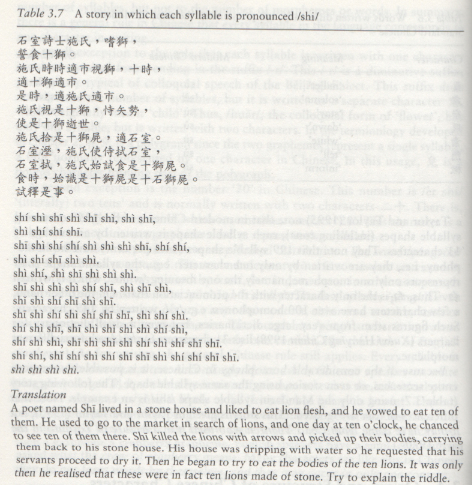
shi shi shi …

shi shi shi

(Apologies for the poor scan. It’s taken from Writing Systems: A Linguistic Approach, by Henry Rogers (Blackwell))

I love this very extreme example of Mandarin Chinese homophony: an entire story made up of a single syllable (though really four syllables of course, taking into account tonal quality).

Various people have recorded this literary masterpiece, the one below being my favorite…

“perhaps culture is now the counterculture” (2, regarding scientism)

Another excerpt from the commencement address recently given to Brandeis University by Leon Wieseltier, long-time literary editor at The New Republic:

Our glittering age of technologism is also a glittering age of scientism. Scientism is not the same thing as science. Science is a blessing, but scientism is a curse. Science, I mean what practicing scientists actually do, is acutely and admirably aware of its limits, and humbly admits to the provisional character of its conclusions; but scientism is dogmatic, and peddles certainties. It is always at the ready with the solution to every problem, because it believes that the solution to every problem is a scientific one, and so it gives scientific answers to non-scientific questions. But even the question of the place of science in human existence is not a scientific question. It is a philosophical, which is to say, a humanistic [one].

Owing to its preference for totalistic explanation, scientism transforms science into an ideology, which is of course a betrayal of the experimental and empirical spirit. There is no perplexity of human emotion or human behavior that these days is not accounted for genetically or in the cocksure terms of evolutionary biology. It is true that the selfish gene has lately been replaced by the altruistic gene, which is lovelier, but it is still the gene that tyrannically rules. Liberal scientism should be no more philosophically attractive to us than conservative scientism, insofar as it, too, arrogantly reduces all the realms that we inhabit to a single realm, and tempts us into the belief that the epistemological eschaton has finally arrived, and at last we know what we need to know to manipulate human affairs wisely. This belief is invariably false and occasionally disastrous. We are becoming ignorant of ignorance.

So there is no task more urgent in American intellectual life at this hour than to offer some resistance to the twin imperialisms of science and technology, and to recover the old distinction — once bitterly contested, then generally accepted, now almost completely forgotten – between the study of nature and the study of man…. You who have elected to devote yourselves to the study of literature and languages and art and music and philosophy and religion and history — you are the stewards of that quality. You are the resistance. You have had the effrontery to choose interpretation over calculation, and to recognize that calculation cannot provide an accurate picture, or a profound picture, or a whole picture, of self-interpreting beings such as ourselves; and I commend you for it…. [You] are the counterculture. Perhaps culture is now the counterculture.

He concludes:

So keep your heads. Do not waver. Be very proud. Use the new technologies for the old purposes. Do not be rattled by numbers, which will never be the springs of wisdom. In upholding the humanities, you uphold the honor of a civilization that was founded upon the quest for the true and the good and the beautiful. For as long as we are thinking and feeling creatures, creatures who love and imagine and suffer and die, the humanities will never be dispensable. From this day forward, then, act as if you are indispensable to your society, because – whether it knows it or not – you are.

Congratulations.

“perhaps culture is now the counterculture”: again, the humanities make us human

I’m not terribly familiar with Leon Wieseltier’s writing – he being the literary editor of the New Republic. But I just came across a commencement address he recently delivered at Brandeis that is about as rousingly superb a defence of the humanities as I’ve ever seen.

An excerpt (and one more in the next post):

For decades now in America we have been witnessing a steady and sickening denigration of humanistic understanding and humanistic method. We live in a society inebriated by technology, and happily, even giddily governed by the values of utility, speed, efficiency, and convenience….

The machines to which we have become enslaved, all of them quite astonishing, represent the greatest assault on human attention ever devised: they are engines of mental and spiritual dispersal, which make us wider only by making us less deep. There are thinkers, reputable ones if you can believe it, who proclaim that the exponential growth in computational ability will soon take us beyond the finitude of our bodies and our minds so that, as one of them puts it, there will no longer be any difference between human and machine. La Mettrie lives in Silicon Valley. This, of course, is not an apotheosis of the human but an abolition of the human; but Google is very excited by it.

In the digital universe, knowledge is reduced to the status of information. Who will any longer remember that knowledge is to information as art is to kitsch-–that information is the most inferior kind of knowledge, because it is the most external? A great Jewish thinker of the early Middle Ages wondered why God, if He wanted us to know the truth about everything, did not simply tell us the truth about everything. His wise answer was that if we were merely told what we need to know, we would not, strictly speaking, know it. Knowledge can be acquired only over time and only by method. And the devices that we carry like addicts in our hands are disfiguring our mental lives also in other ways: for example, they generate a hitherto unimaginable number of numbers, numbers about everything under the sun, and so they are transforming us into a culture of data, into a cult of data, in which no human activity and no human expression is immune to quantification, in which happiness is a fit subject for economists, in which the ordeals of the human heart are inappropriately translated into mathematical expressions, leaving us with new illusions of clarity and new illusions of control.

linguistics in a flow chart (ish)

66707_591555647528757_353120791_n
(click for higher resolution)

Well, I feel sorry for the oft-neglected morphologists, neglected again. As the bridge between phonology and syntax, their work tends either to be tacked onto the former or the latter, for some reason, denied sovereignty.

Beyond that, this is quite clever, though of course necessarily schematic. I don’t really fit, since my answer to the very first question channels me into only one option – which is not where I’d want to go. But when I choose the answer “several,” instead of “as many as possible,” it does in fact bring up the half of the diagram I’m most interested in, especially syntax, semantics (although the non-math kinds like lexical and cognitive), and pragmatics. (Hmm, but both first and second language acquisition are completely fascinating also – I suppose it’s only the upper right quadrant that holds less of an interest for me.)

Obviously the main purpose was to give some general sense of the range of linguistic enterprise while having some fun at the same time (can’t syntacticians function with young children?!).

It’s interesting how little the general public still knows about what linguists do. The most common view of course is that “linguists” simply learn many languages, ie that they are polyglots, rather than that they study language as such. So this chart may be helpful in giving a sense of the range of areas involved in the study of language, even if a little (tongue-in-) cheekily.

Paul Scott’s Raj Quartet

The New Republic has a wonderful appreciation, by Peter Green, of Paul Scott and his Raj Quartet (available in two handsome volumes in the Everyman’s Library here and here).

Green met and became friends with Scott during the war, in Calcutta, then later, back in London and interviewing for a literary agent in the ’50s, he found himself, purely coincidentally, seated across a desk from him. Scott served him as agent for six years, at which point – in 1960 – he became a full-time novelist. Several years later Green moved with his family to Greece for eight years, and then took up an academic post in the US (he is an esteemed classical scholar). So for the most part their contact during the last 15 years of Scott’s life was limited to letters.

The essay well captures what is so monumental an achievement in the novels:

What has always astonished me about The Raj Quartet is its sense of sophisticated and total control of its gigantic scenario and highly varied characters. The four volumes constitute perfectly interlocking movements of a grand overall design. The politics are handled with an expertise that intrigues and never bores, and are always seen in terms of individuals. Though Paul always saw the inevitability, and the necessity, of an end to the British occupation, and exploitation, of India, he still could see, and sympathize with, the odd virtues that the Raj bred in its officers. No one—certainly not E. M. Forster—has ever produced a subtler, more nuanced, picture of the Raj in action during its last fraught years, or of the seething, complex, and wildly disparate nationalist forces arrayed against it.

Evidently the ten-year process of completing the book took a shattering toll on Scott’s health; terribly sadly he didn’t live long enough to receive the full appreciation that would eventually come his way. Green’s essay spends some time pondering the mystery of the Quartet’s origins. In particular, he wonders how so great an achievement suddenly appeared, fully formed, out of the author’s previous corpus of work, which he describes as “good, but not in any way really exceptional.”

The Quartet remains a tour de force virtually without rivals. The question is, how? How did this middle-class suburbanite—who left school at fourteen, had no experience of diplomacy or the civil service, in India or anywhere else, and never set foot inside a British university in his life—suddenly, after a solid but hitherto no more than middling literary career, acquire the vision that brought the world of the fading Raj to unforgettable life, in a quartet of novels that for range and power have been compared to Tolstoy? Suggestions have not been wanting, most notably that his experience on the wrong side of the rigid social divisions operating in pre-war London suburbia gave him a sharpened insight into both native caste distinctions and the even more absolute British color-bar that he found in India. Others have pointed to his sexual ambiguity… There may be some truth in both of these theories, but since both stem from Paul’s early life, why did they not have the same transforming effect on his early fiction as they are alleged to have done on The Raj Quartet? The difference is as total, and as extraordinary, as the still not fully understood process by which a chrysalis becomes a butterfly.

“My Reincarnation” (documentary)

Screen shot 2013-05-16 at 10.40.02 PM

Screen shot 2013-05-16 at 9.47.48 PM

This one took me by surprise. It’s a film documenting the relationship between the Dzogchen teacher Namkhai Norbu and his son, now known as Khyentse Yeshe (Dzogchen is a term indicating the pinnacle and most direct path within the ancient Nyingma tradition of Tibetan Buddhism.) Filmed over the course of 20 years by Jennifer Fox, it surely must represent the most intimate visual portrait of a Tibetan lama to date. At times watching it, in fact, it’s hard to fathom how a family would put up with that degree of intrusion for so long: we see them at the dinner table, preparing for teaching events, and discussing all kinds of personal matters. It caused me to remember a comment in one of Trungpa Rinpoche’s books, to the effect that a bodhisattva has no room for privacy in their life at all, is completely open to the demands of the world.

Screen shot 2013-05-16 at 10.40.44 PM

Namkhai Norbu, like a number of eminent teachers but unlike so terribly many more, managed to escape over the mountains from Tibet in 1959, during the Chinese invasion. He ended up in Italy, where he still lives, and married an Italian woman. At the beginning of the film his son Yeshi – as he was then called – is about 17, deeply respectful of his father but not all that connected to the practice of buddhism. We hear him lament the relationship he has with his father, which lacks the kind of ordinary, Italian familial warmth he wishes for.

Screen shot 2013-05-16 at 10.39.51 PM

But that relationship contains an added wrinkle, because Yeshi, when still in his mother’s womb, was “recognized” as a tulku, the rebirth of a lama – in this case Namkhai Norbu’s own uncle, Khyentse Rinpoche (not the most famous such with this name, Dilgo Khyentse Rinpoche, but a lama who died in Tibet at the hands of the Chinese). Without pressuring his son either to take up his vocation or even to practice, he nonetheless has made it clear how important a responsibility he feels is on Yeshi’s shoulders. And many others around him, too, have high expectations and await the time when he will begin to manifest as a teacher. Yeshi himself remembers many dreams he had at a young age of particular places in Tibet he had of course never seen. However, he chooses a job in the business world, marries, and begins raising a family.

The film moves leisurely through the years, giving us glimpses of Namkhai Norbu teaching and relating to his students.

Screen shot 2013-05-16 at 9.38.03 PM

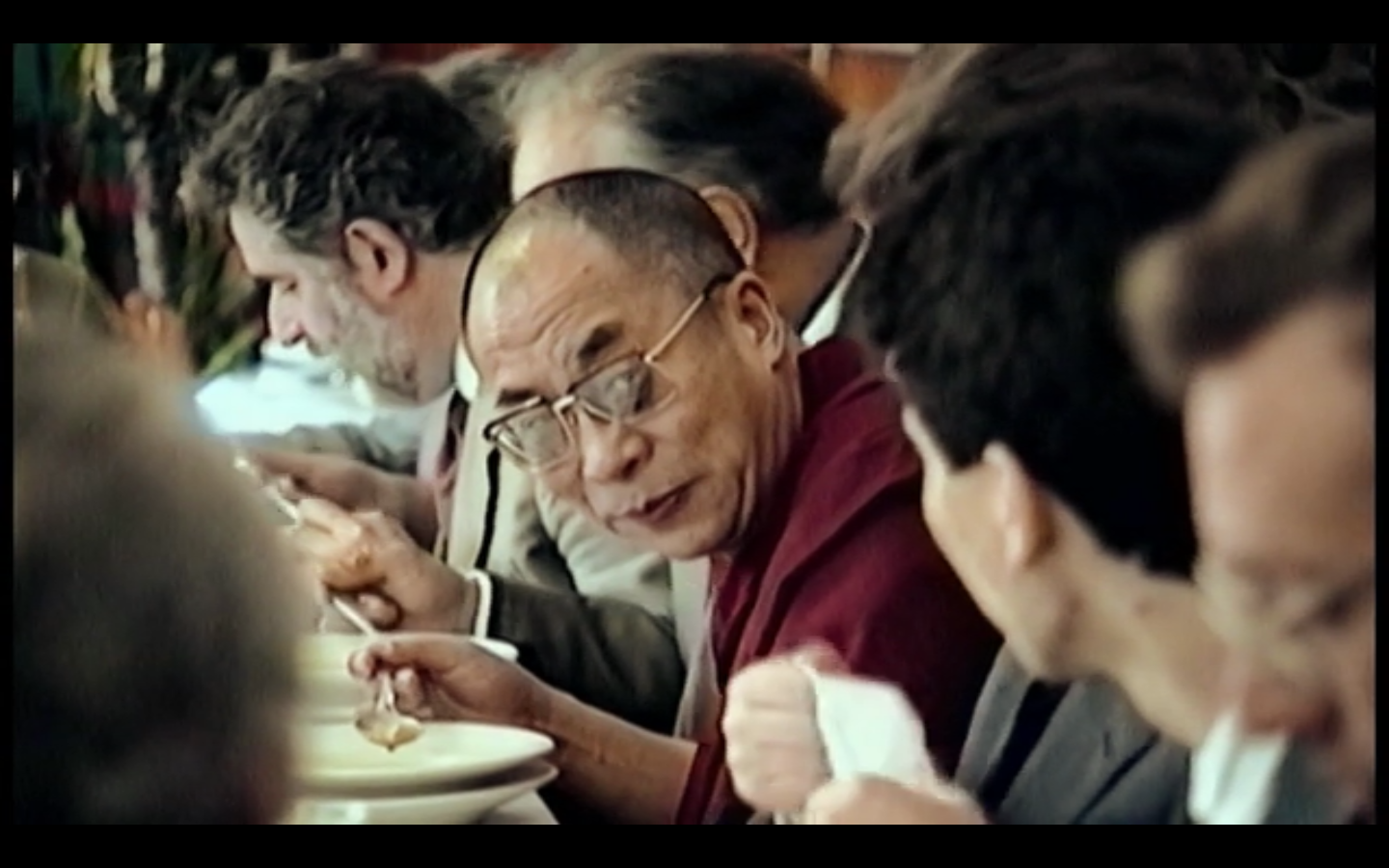
We see him, very ill, in a hospital bed, and then well again and out in the world (having decided, he says, that he needed to stay alive and continue teaching). And we also see – a highlight of the film – wonderful and equally up-close footage of the Dalai Lama during a visit to Italy (in the stills below Yeshi at about 17 is in the foreground).

Screen shot 2013-05-17 at 1.21.17 PM

Screen shot 2013-05-17 at 1.21.27 PM

Screen shot 2013-05-17 at 1.21.37 PM

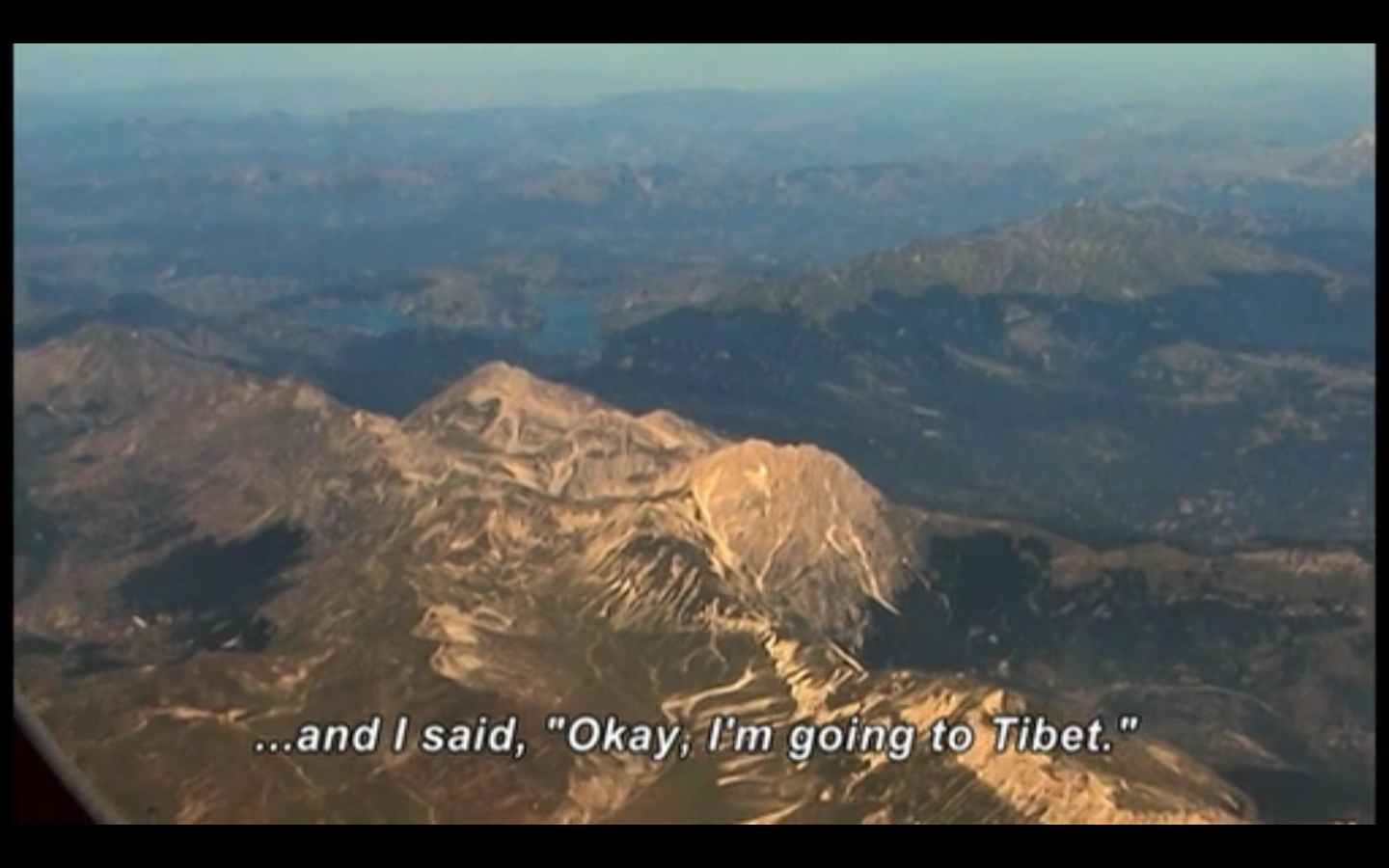
At a certain point I realized the film had crept up on me in a remarkable way. Yeshi begins involving himself more and more in Dzogchen practice and helping his father during teachings and empowerments. And then one day, without particular fanfare, he decides finally to visit Tibet, where he has been awaited by students of the previous Khyentse Rinpoche for over 40 years…

Screen shot 2013-05-16 at 10.30.03 PM

Those for whom the entire tulku system is alien and maybe even suspect might not know what to make of this portion of the film. I place myself somewhat in the middle between such a group and those who have strong faith in that system – though probably a little closer to the former – yet I found these scenes very moving.

Screen shot 2013-05-16 at 10.34.51 PM

The film ends with Yeshi beginning to teach as a lama himself – in a casual, 21st-century-style. He comes across as very genuine and open throughout the film, and in a scene between him and his father at the end there is a greater ease between them that is lovely to see. Here, Namkhai Norbu is playing the flute and joking that it would have been “much easier” if he’d chosen to be a musician instead of a teacher…

Screen shot 2013-05-16 at 10.42.47 PM

Screen shot 2013-05-16 at 10.42.57 PM

In fact, I liked this so much I ended up watching it again a couple of days later… All in all, quite a beautiful look into the life of a beloved Tibetan lama, the pressures and difficulties of being a son of whom very much is expected, and the journey which the latter takes to come fully into his own.

Screen shot 2013-05-16 at 10.13.36 PM

scientific certainty

(from an interview in the current issue of Buddhadharma with biologist Rupert Sheldrake):

In 1894, Albert Michelson, later to win the Nobel Prize in Physics, declared, “The more important fundamental laws and facts of physical science have all been discovered, and these are now so firmly established that the possibility of their ever being supplanted in consequence of new discoveries is exceedingly remote… Our future discoveries must be looked for in the sixth place of decimals.”

Whoops. Within a generation quantum theory and general relativity would bring about such an “exceedingly remote” possibility.

Today the same kinds of claims are made for a great many theories that not only haven’t been established by centuries of rigorous work – as Michelson’s physics was. They haven’t even been properly understood, delineated, and “proven” the first time around. I’m talking about the infiltration of scientific certainties into various social “scientific” domains. Wild claims about genes for such notions as “gregariousness,” “altruism,” and “criminal personality” appear every week. But it is hard to see how these kinds of concepts are anything but trans-scientific in their profoundly imprecise and contingent natures.

(Even a one-dimensionally, completely measurable trait like height has about fifty genes connected to it, together only accounting for roughly 5 percent of a given person’s actual height, according to Sheldrake.)

That is to say, to quote from the interview again: “…human meanings, values, and purposes can only be understood in the context of human societies, traditions, philosophies, religions, and experiences.”

adieu Waterfront Video…

I haven’t been attached to a great many stores in my life but have been realizing over the past couple of weeks how much I will be missing Waterfront Video, which closed its doors on April 30 after nearly 17 years in business – I’d been a customer for the past six of those. (I unthinkingly began to link to their website just now, then remembered that of course it wouldn’t still be up, except that it turns out it is – which is even sadder…)

Waterfront made it far longer than most video stores in the country, in part due to the willingness of its owner to keep it going no matter what, and in part because it was quite special. It had a stock of something like 30,000 videos, a great many of which will never find their way into Netflix: all kinds of foreign, older, obscure, quirky titles that were always a pleasure to browse through no matter how many hundreds of times I’d been in the store. And the staff were the best – always cheerful, always happy to talk about movies.

Its loss has reminded me yet again of how relentless is the internet’s whittling away of physical, ie real, community. Since I happen to live alone, some nights a visit down there served an added function of connecting with the world in a small way, having a chat with the folks behind the counter, seeing what was new.

Netflix just ain’t the same, at all… They do their best and my queues aren’t going to run low anytime soon, but again, there will never be anything close to the selection of less popular films available there, with the streaming catalog being of course even more limited. One of the best things about Waterfront was that if at 9:00 you suddenly remembered a movie you really wanted to see, you could go down there and more often than not pick it up, having it back home ten minutes later. And with their 4-for-3, five-day-rental deal, you could bring back a varied selection in case your first impulse didn’t grab you. But in that situation now, if Netflix hasn’t got it on streaming – and the chances aren’t very good that it will – you’re out of luck. So even at the level of convenience, which is what online commerce is supposed to be all about, it’s a serious loss.

Who knows, maybe one day specialist providers might appear and over time build up eclectic collections of film that might come (somewhat) close to matching Waterfront Video. But even so they can never replace the experience of being in a real-live space, surrounded by real-live people, being able to browse through real-live video covers. My very last batch of four included films by Kieslowski, Jarmusch, Howard Hawks, and Ozu – none of which, and in fact probably none or almost none of whose films at all – are available on Netflix streaming. Sure, having to pay late fees sucked, but mainly because I was just too disorganized to get things back in time…

I was also really saddened to read in the Seven Days article of the loss of George Holoch, who’d worked at Waterfront almost from the beginning. He was an award-winning translator of French, with numerous books to his credit, and a nice man to chat with when I happened to be in there during the day, which was rare. My memory is of him reading The New York Review of Books with a late Beethoven Quartet playing over the speakers.

So another loss to “progress.” It’s going to take probably a few months before the thought stops popping into my head at 9 or 10 at night: hmm, maybe I should pick up Wings of Desire, just in case I feel like putting it on later, or see what’s just come in… Adieu Waterfront.

Cocteau Twins, Michael Franti, Radiohead

So my journal asked me what I would like for my birthday and I just said: “you know.” And lo, the following post has appeared…

So first up – oh yes, possibly the single most sublime song from one of the sublimest bands ever to have blessed the Earth. I have surely heard this at least 400 times, and somehow … it’s still every bit as heartmeltingly great.

And then there is a lullaby for the world from Michael Franti…

And … a dangerous final choice… Something about this that’s almost too shatteringly perfect for human ears…

“Futility” – Wilfred Owen

Move him into the sun –
Gently its touch awoke him once,
At home, whispering of fields unsown.
Always it woke him, even in France,
Until this morning and this snow.
If anything might rouse him now
The kind old sun will know.

Think how it wakes the seeds, –
Woke, once, the clays of a cold star.
Are limbs, so dear-achieved, are sides,
Full-nerved – still warm – too hard to stir?
Was it for this the clay grew tall?
– O what made fatuous sunbeams toil
To break earth’s sleep at all?

subu: a Georgian case-study in drugs policy

There is an interesting piece by Graeme Wood over at The New Republic on how Georgia dealt with the sudden epidemic in opiate use that began around the year 2000.

A drug called buprenorphine or Subutex (“subu” on the street) entered the country via France, where, in the mid-90s, it had become the most widely used substance in drug-substitution programs – ie for weaning addicts off of heroin. Evidently it is far superior to methadone in this regard: a mere 5% of the 2000 Georgians currently in a methadone program will ever come off successfully, according to a clinic director cited in the article. And methadone is dangerous too, building up in the body and causing an estimated 5000 deaths in the US each year. Subutex, on the other hand, appears to be much safer, several times longer-lasting than heroin (a single dose will reach 12-24 hours), and mellower, enabling users to function at a job quite normally for the most part.

So the drug arrived in Georgia, and at a time of high unemployment its popularity rapidly soared, to the point where some 1 in 20 Georgians, according to the article, were using “hard drugs.” Syringes littered the parks, tunnels, and alleys of Tbilisi.

What happened next makes for an interesting case-study in drug policy. Georgia’s new president at the time, the Columbia Law School-educated Mikheil Saakashvili, chose a US-style zero-tolerance policy – and then some – to stamp out the Subutex epidemic. Anyone at any time – 53,000 in 2007 – could simply be stopped on the street and forced to give a urine sample. First-offenders were fined, second-offenders imprisoned, causing the Georgian prison population to triple between 2004 and 2010.

According to the article, there have been two results of this extremely energetic and draconian set of policies, one perhaps surprising, the other depressingly familiar.

The surprising result is that, apparently, Subutex scarcely exists in Georgia today. From that standpoint, the policy was successful. But then, what has happened to all those addicted to it? Have they suddenly all gone drug-free? Well, some have, and a great many haven’t. The difference is that those who haven’t are now in greater danger.

Wood spent time interviewing “Pavel,” a law school graduate unable to find work in his field who operates a market stall and has been shooting up one thing or another for more than 15 years. After his release from prison, with no more of the relatively safe and controllable Subutex around, he turned to a horrifying concoction known as krokodil, consisting of codeine, toilet-cleaner, red phosphorus, and lighter fluid, which is as health- and soul-destroying as you would imagine it could be.

Now he is in a methadone program – with, again, a 5% chance of success, and at greater risk than when Subutex had been available.

One of Wood’s main points is that drug policies always create unexpected and mixed results even at the best of times. He notes that where – as in Ohio in 2012 – the smuggling trade in OxyContin has been broken up, heroin has a tendency simply to come in and fill the void.

Surely there are few public policy spectacles more depressing than the “drugs war,” which seems completely immune to all common sense and compassion. It’s hard to guess how much longer it will take before we recognize that criminalizing the profoundly human desire for intoxicants – found in all times and places – simply cannot succeed. Building a fundamentally saner, more nurturing and uplifted society would seem to be the only way that the more destructive forms of intoxication can diminish in attractiveness.

Far easier, however, to condemn those whose circumstances and history led them to a substance that happens to be different from one’s own…

“Take pleasure in the mid day”: Siri and Google Voice (try to) have a conversation…

… and remind us just how utterly human is language.

Why is language understanding/production so stupendously difficult to inculcate in a machine/software? Consider the various levels:

1) A language’s sound system is never simply a one-to-one mapping from symbol to a set of articulations, because sounds are always affected by their surrounding context too, in all kinds of ways. We’re almost entirely unconscious of this as we speak, but software must explicitly calculate everything. So every form of assimilation, say – whether it be forward-looking (anticipatory coarticulation), or as it were backward-looking (perseverative) – represents an additional syllabic possibility, and as English contains many homophones (though not even nearly as many as, say, Japanese), software has to come up with higher-level criteria in order to select one over another. Leading to:

2) All the intricacies of morphosyntax, which represent a creative capacity fundamentally irreducible to sets of algorithmic procedure.

3) But then, at the same time as a machine is grappling with all of that, it comes up against the semantic component of language, which again is an unthinkably more sophisticated system than a mere cataloguing of potential meanings word-by-word and phrase-by-phrase, involving intricacies within intricacies of nuance – figuration, irony, suggestion, metaphor, and on and on…

4) And even this isn’t the end of a poor machine’s travails, because semantics then shades into the level of language known as pragmatics, which involves everything connected to context (personal, social, cultural), and cohesiveness and reference internal to the entire current discourse – in short, a multitude of different kinds of understanding between people which don’t need to be explicitly expressed.

The end result of all these layers of difficulty?

We quickly go from: “…I expect some degeneration. Human Computer Interactions are prone to error, frustration, and often amusement. Humorous incongruities arise and superiority humor emerges as we take pleasure in the mistakes, misunderstandings, and limitations of software and machines.”

To: “I think that the generation human computer interactions airport to wherever castration in the office at and if you have to call me at either white and Terrier already and we have urgent that we take pleasure in the Patriot understanding on limitations of software and leaking.”

?!?!

more on James Purdy and the “via negativa”

In the previous post I had recommended a fine piece on James Purdy’s short novel In a Shallow Grave. It is by Don Adams and can be found here, in the online journal Hyperion.

I’d tried to read some of Purdy’s work awhile back and was unable to finish. There is certainly no one quite like him, and he is not for everyone. His fictions continually push various kinds of stylistic, narrative, and thematic boundaries. The worlds he creates are never comfortable – or predictable. They contain much loneliness and repression, grotesqueries and obsessions, strange sudden violence.

I just made another (successful, this time) attempt however, with a different book – the aforesaid In a Shallow Grave – and after a day or two of absorbing it a bit further, letting it settle, have realized there is much I appreciate in it. Don Adams’s essay has helped further my understanding, making a strong and well-rounded case for the novel as spiritual allegory.

The story concerns – and is written in the rough narrative voice of – a man called Garnet Montrose, a war veteran so horribly disfigured by injuries that his appearance resembles someone turned inside out, his vein-exposing face (the color of “mulberry wine”) instantly emetic in effect to those who catch sight of him. He spends his days on the property he has inherited – near the Virginia coast – reading (or rather being read to) completely randomly from the miscellany of books in his grandfather’s collection, most of which he barely comprehends, having only received an eighth-grade education.

Into his life appear two “applicants,” helpers, somewhat younger men – one black, one white – one of whom reads to him and massages circulation back into his feet, the other of whom takes down dictated letters to Garnet’s old sweetheart, “the Widow Rance,” and delivers them, and who also, well … this is the mystery of the book, because this second “applicant,” one Potter Daventry, emerges as a strange kind of Christ-figure, though not quite like any I’ve come across before. There’s also an old deserted dance-hall – Garnet’s great “secret” – and a hurricane finale.

It’s a strange ride, but not without its own mysterious touches of tenderness and beauty. Garnet at the start of the novel is a man more than half-dead, a man whom almost no one can set eyes upon without uncontrollably retching. But the experience of love comes to him in unexpected and inexplicable ways, from Daventry, and from Garnet’s other companion, Quintus Perch.

I like this summation from the Adams essay:

[Purdy] … flies in the face of our intellectual culture’s predilection to believe that human nature and experience may be accounted for rationally in terms of the behavioral sciences. According to such theories, human nature is a series of hard-wired drives and impulses, genetic encodings and cultural adaptations, that may be thoroughly explored and explained, given a limited social and cultural context… Purdy’s entire effort as a fictive creator is to counter such assumptions regarding our ability to account rationally and exhaustively for human nature and experience as a whole. In his interview with Christopher Lane, Purdy bemoaned the failure of critics to comprehend his counter-conventional fiction, noting that, “intellectuals are the worst sinners because they want everything clear and life is not clear.”

Purdy’s fictive contrariness and negations, his creation of characters and worlds that are inexplicable in and through the behavioralist thought systems by which we typically account for our realities, is that against which readers habituated to mimetic realism often instinctively rebel when first encountering his fiction, as my experience with my students demonstrated. But readers who are willing to engage the text’s alternative realism on its symbolic and archetypal terms eventually come to understand that Purdy’s multiple-ramifying allegorized world, which refuses the consolations of the conventional in affirming the unfathomable mysteries of being, is paradoxically more true to life and more respecting of the real than the fictive mimicries of actuality we are more accustomed to encountering and consuming. For these willing initiates, Purdy’s unconscious allegories … serve as fictive revelations, prompting them to discover the affirming power and purpose of negation for their own lives and worlds.

Pseudo-Dionysius and the Heart Sutra

In an insightful reading by Don Adams (in Hyperion) of the James Purdy novel In a Shallow Grave, discussing the book as an allegory of the via negativa, I discovered this quotation from “Pseudo-Dionysius,” a theologian who wrote most likely around 500 CE:

The “Divine Cause of all,” says Dionysius:

…is not immovable, moving, or at rest. It has no power, it is not power, nor is it light. It does not live nor is it life. It is not a substance, nor is it eternity or time. It cannot be grasped by the understanding since it is neither knowledge nor truth. It is not kingship. It is not wisdom. It is neither one nor oneness, divinity nor goodness…. It falls neither within the predicate of nonbeing nor of being. There is no speaking of it, nor name nor knowledge of it.

This cannot help but remind me of the famous language of the buddhist Heart Sutra:

Form is emptiness; emptiness also is form. Emptiness is no other than form; form is no other than emptiness. In the same way, feeling, perception, formation, and consciousness are emptiness…. There are no characteristics. There is no birth and no cessation. There is no purity and no impurity. There is no decrease and no increase. Therefore, Shāriputra, in emptiness, there is no form, no feeling, no perception, no formation, no consciousness; no eye, no ear, no nose, no tongue, no body, no mind; no appearance, no sound, no smell, no taste, no touch, no dharmas; no eye dhātu up to no mind dhātu, no dhātu of dharmas, no mind consciousness dhātu; no ignorance, no end of ignorance up to no old age and death, no end of old age and death; no suffering, no origin of suffering, no cessation of suffering; no path, no wisdom, no attainment, and no nonattainment. [translation by the Nalanda Translation Committee]

It has long struck me that genuine wisdom traditions tend to have – and need, in order to be in a healthy state – both a “positive” and “negative” View, in balance with one another. By these terms are meant, respectively, a View which aims through language to reach – as near as possible – to a description of the nature of reality itself, and one which frustrates, which leads the inquirer explicitly away from, such an attempt.

Christianity seems to me largely to have lost the latter, leading to certain long-standing imbalances. Without a via negativa, the basic View of a spiritual tradition has a tendency towards reification and indeed, potentially, ossification. The approach of negation continually opens perception up and out, aerates it, maintains freshness and clarity. It reminds the practitioner of the fundamental ungraspability of truth. Indeed the negative way might, it seems to me, even be thought of as the approach of spaciousness.

Interestingly, buddhism more often suffers from the opposite problem to Christianity…

In the buddhist tradition, broadly speaking two ancient philosophical approaches predominate, again one “positive,” the other “negative.” The positive approach can be seen in the Cittamatra or “mind-only” school, the latter in the Madhyamaka. Madhyamaka – “deconstruction” some 2000 years avant la lettre – makes no positive assertions whatsoever about the nature of reality. Rather, it is purely a technique for revealing the inescapably relative nature of all such statements – both positive and negative! We seem to need both perspectives. A purely “positive” philosophy has a tendency towards “eternalism,” the denial of thoroughgoing interdependence, while a purely “negative” approach might lead to nihilism, its counterpart. Or – as sometimes happens within buddhist communities – to a certain coldness or harshness, or worse.

More generally, in the ravings of fundamentalism we see most clearly what happens when (in the old Zen parable) the pointing finger is mistaken for the moon, when the inherent relativity of all language, all concept, is forgotten.

A bit more on James Purdy in the next post.