Mint Restaurant

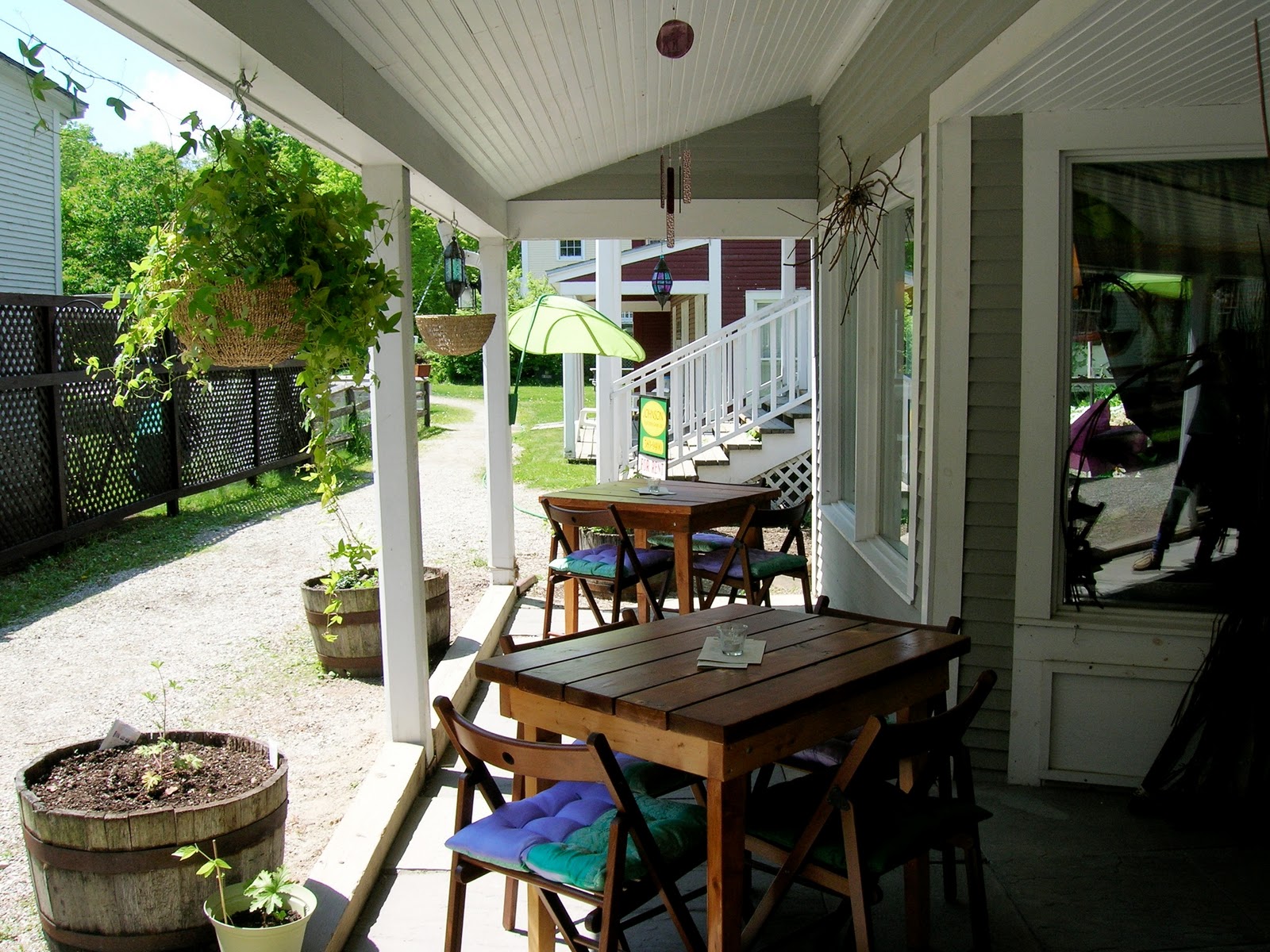
About a year ago I discovered Mint Restaurant in Waitsfield, a lovely village in Vermont’s Mad River Valley. It’s about a 45 minute drive for me but I try and make it down whenever I can. (The drive is beautiful too.) Savitri and Iliyan are the creators, and do it all! They came to Vermont from the opposite corner of the US in just about every way (LA), and before that from Hungary and Bulgaria respectively. And they bring a love of inventive, richly and complexly flavorful, and healthy dishes inspired by cuisines from all over the world.
DSCN4275

(photos from the Mint website except where noted)

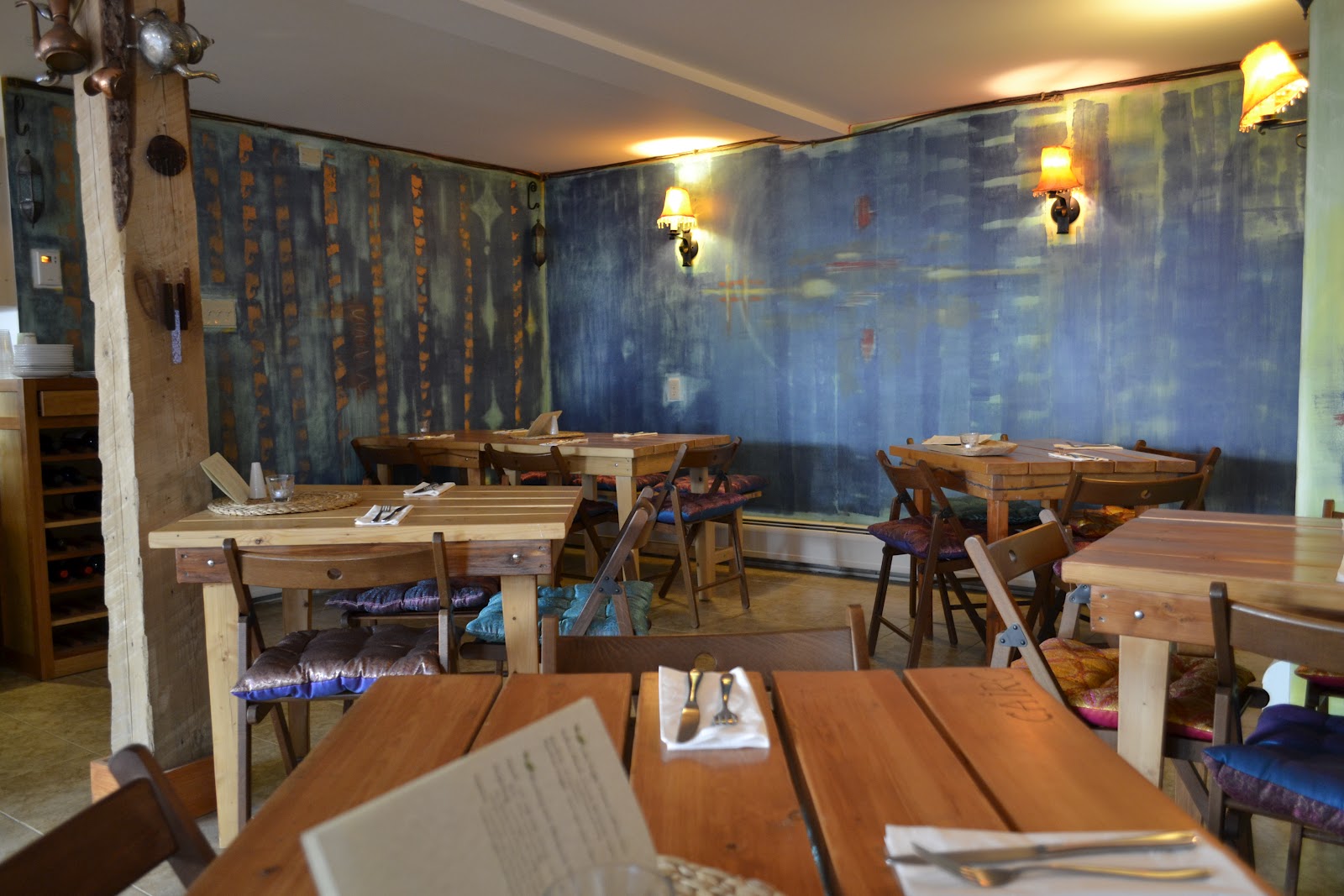
What makes for a truly special restaurant? I think you have to start with environment. It’s true that I’ve occasionally had great food in “hole-in-the-walls” – remembering a South Indian restaurant in South London which was a few formica tables stuck in what felt like a 1950s kitchen, harsh lighting, mostly bare white walls, but whose food was out of this world.

But an uplifting, restful, warm environent raises a meal to a whole other level. And I appreciate spaces in which all the details – materials, colors, design, lighting, music – are carefully chosen and thought through. When I step into such a room, something inside instantly relaxes and feels it is at home. I actually feel more nourished, and definitely more cheerful and peaceful, after such a meal.
_DSC0168

_DSC0171

Moving on to food, Mint is special in several ways. Firstly, it is actually vegetarian! That exclamation point is there because, as someone who has been a veggie since high school, a vegetarian restaurant in and of itself is a MAJOR EVENT. At least it is here in Vermont (I believe Mint is the only such restaurant in the state). Meat-eaters take for granted that when they pick up a menu they have the choice of the whole thing. Vegetarians take for granted that when they do the same, usually at least 3/4 of it, often more, has to be filtered out immediately in order to focus on the 2 or 3 choices there will be for a main course. And for some reason these will often be fairly unimaginative, alas. So it’s such a luxury to know that literally everything is orderable. To not be a second-class citizen for a change!

_DSC0174

_DSC0177

Secondly, the menu changes every week. There is one starter that is a regular feature, the fabulous “Mint salad” (baby spinach, baby arugula, snow pea sprouts, pears, toasted almonds, shaved Parmigiano Reggiano and fruit juice sweetened cranberries, tossed in a mint vinaigrette), and one main course (a large bowl of curly kale steamed and braised in tamari, garlic, orange juice, fruit juice sweetened cranberries, steamed broccoli, black turtle beans, brown rice and creamy tofu sauce). Apart from these, four new starters and four new main courses appear each week. So there is always something different to try.

_DSC0117

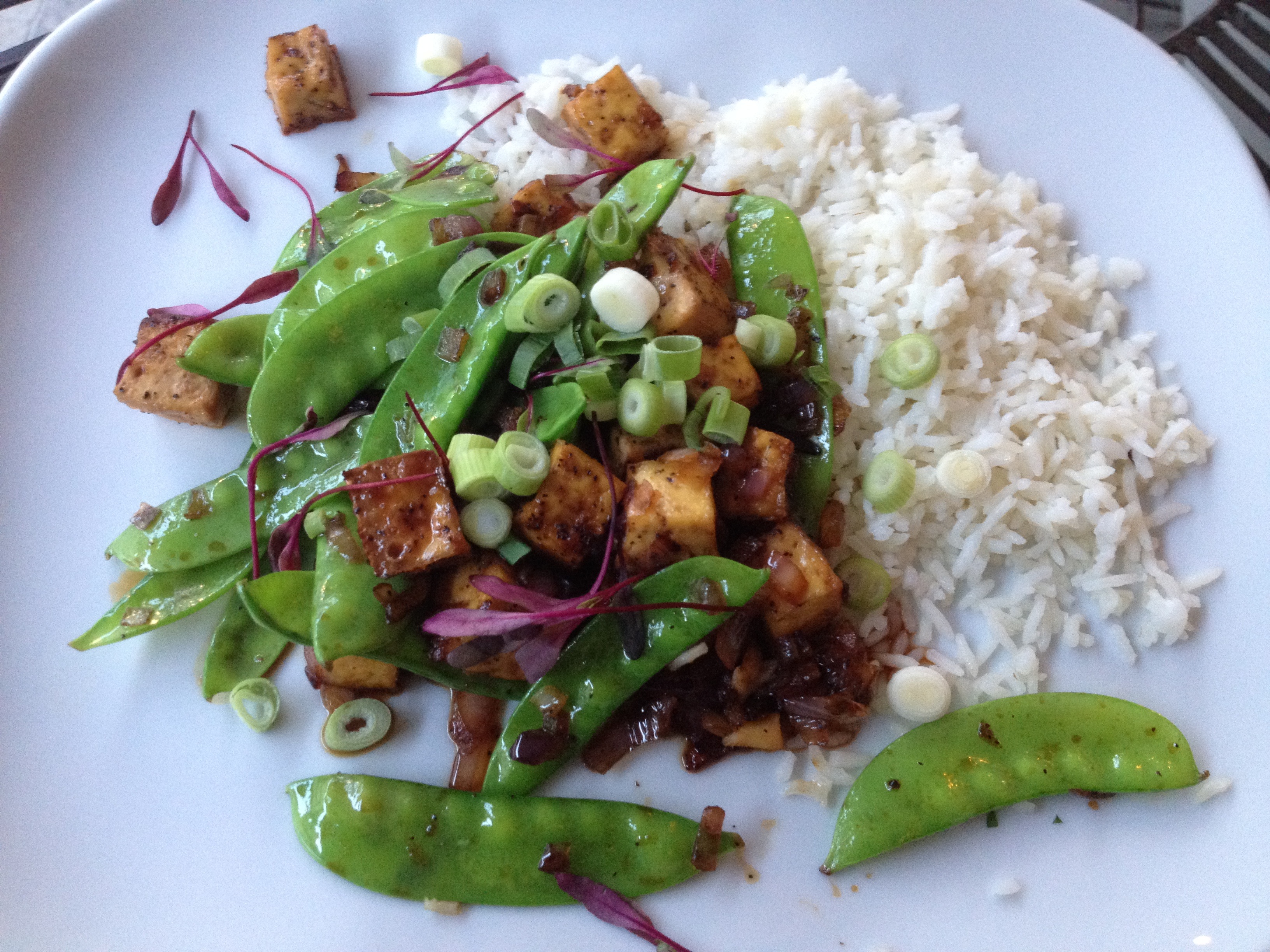
Ingredients are, of course, at peak freshness, and organic and local whenever possible. But what’s best about dinner at Mint is that every dish has been created, with artistry. Nothing is taken for granted, neither flavors, textures, or colors. The dishes are just consistently delicious, often with deep, rich flavors, and beautiful to look at. Even in the case of more familiar items, there are often one or two touches that surprise me – some idea or ingredient or variety of sauce I hadn’t come across in that context.

Mint 2

(photo taken by me – though I only had the idea after starting to eat, hence that half stuffed grape leaf…)

And then it’s the sheer range of styles too that’s special. Have a look at a few of their menus from week to week. Only those meat-eaters who feel they simply need to have meat at every meal would miss it at Mint. And even then, if part of that craving is textural, I would recommend checking out what Iliyan can do with tempeh, which involves part-baking (along with marination) and is really special. Or seitan for that matter.

The menu is rounded off with a few desserts – equally distinctively Mint – and an extensive selection of excellent teas. Coffee, beer, and wine are also available.

DSCN4628

Mint survived major flooding damage due to Hurricane Irene in 2011 despite failing to receive any compensation from their insurance company. Savitri and Iliyan reopened a year ago, on New Year’s Eve, and I’m very glad they did. I find a great meal to be such a celebration of life, bringing much good cheer.

So if you live in or visit Vermont, I do recommend stopping by. And to Mint a big thanks for all you do – joyful New Year!
Mint 1

(my photo)

Brahms Intermezzo Op. 118, No. 2: the extremes…

I learned this recently, Brahms’ most famous piece for piano. It dates from 1893, near the end of his life. Everybody, it seems, plays it, and there are literally many dozens of recordings on YouTube to sample. I’ve been living with the piece for a couple of months now, thinking through it.

In the process I’ll listen to another recording from time to time and have probably heard 20 or more by now. Oddly, the great majority of these I’m just not crazy about. Partly this has to do with the way the piece is heard as a whole – the role the different sections have.

For example, those 8 bars of slow-moving pianissimo chords about halfway through really seem to me to be the fulcrum of the piece, in a sense. The design is more-or-less A B C D C’ B (abbreviated) A. A, B, and C sections flow throughout with eighth notes, but those eight bars right at the center have full quarter-note chords in each hand. They are, again, pianissimo, and also bear the slowest tempo marking of the piece. They really need to be hushed, startling. And often I find this just doesn’t come through.

Quite a few pianists also tend toward an extreme with this piece tempo-wise. They either go for a faster tempo with, I feel, just a bit too much restraint, or else (more usually) they milk every … single … note…

Here’s one recording I love – from Radu Lupu:

I play this at pretty much exactly 6 minutes, which probably isn’t far from the average. But to give an idea of how great a discrepancy there can be in the interpretation of a piece, consider the fact that Wilhelm Kempff plays it at a near-breathless 4:29, while Ivo Pogorelich clocks in at 8:51. Now that’s one vast difference in view between world-class pianists. But it gets even crazier: there’s a live performance of Pogorelich’s that manages to draw the piece out to a truly symphonic 10:45!

I must admit, I don’t connect very well with Pogorelich here. I made it through each of these once, and tried to keep an open mind. But for me the soul of the piece is lost in places – its flow. The live performance especially doesn’t even sound like Brahms to me. It’s just … painful. Pogorelich is famous for unorthodoxies of various kinds, especially tempi, but this feels a little off the charts. At a couple of points I really thought he might actually just … stop for awhile. (I will try again sometime though.) On the other hand it’s quite possible to go the other way and miss a number of moments of pure exquisiteness through trying to avoid excessive rubato of that kind, as I somehow feel Kempff does.

The piece is very delicate and special, extremely beautiful. And hard to get just right. I took to it somehow and learned it quickly – some pieces just lie under the fingers and others really take their time. But for whatever reason I’m more pleased with the way I play this than with anything I’ve learned in quite awhile. I may even see if I can record it at the recital hall and if so will post.

“big brother” e-textbooks

A story in The Chronicle of Higher Education almost seems like some kind of Onion parody to me, but it’s not.

CourseSmart, a company which sells digital textbooks, has just developed a means to “track students’ behavior: how much time they spend reading, how many pages they view, and how many notes and highlights they make. That data will get crunched into an engagement score for each student.” Several universities are running pilots of this system next year.

“The idea is that faculty members can reach out to students showing low engagement, says Sean Devine, chief executive of CourseSmart. And colleges can evaluate the return they are getting on investments in digital materials.”

Seriously? It used to be that things like, I don’t know, let’s call them “class participation” and “quizzes,” “papers” and “office hours,” stuff like that, were considered reasonable means for determining where a student might be having difficulty with a class…

I have trouble seeing how the amount of time (supposedly) reading and number of pages (supposedly) viewed could accurately assess such a thing. Some students read more quickly than others because they concentrate better; others might sit with a page open for half an hour because they’re actually watching a movie and only occasionally glancing at the text. Some skim through every page but without comprehension; others have greater background on the subject and are able to put the material into context in a more efficient way than the norm.

As for the number of “notes and highlights” a student makes: ?! Some people don’t make any in books, preferring the taking of notes by hand as a way to absorb and think through material. On the other hand, some students highlight half the lines on a given page in yellow and it doesn’t seem to help.

In the pilot programs, students will be allowed to opt out, and there’s nothing wrong with trying something new of course. I just can’t see this idea going anywhere. Seems like it’s moving away from where we need to be, which has to do with direct personal engagement – not “crunching data into an engagement score.”

climate change: an elemental view

Brendan Kelly, an acupuncturist and herbalist, also writes on Chinese medicine and is completing a book on climate change from this perspective. His approach demonstrates how necessary an elemental/energetic view is in confronting the multi-faceted challenges we face.

ws_Steppe_Trees_1024x768

Our culture looks to science-technology to solve more-or-less everything, but the very expectations and attitudes we bring to problem-solving can also contribute to the mess. What Chinese medicine brings is an ancient and deep way of seeing, one which recognizes complete interdependence at all levels of our experience, inner and outer. So normally we think: climate, ah, “outer,” and ask technology to fix all such “external” problems. Isolate something we can improve, and pretty much ignore everything else.

The trouble is that this “everything else” is always, inherently, inseparable from what we’ve extracted from it, and there’s nothing we can do about that. So solving deep-rooted problems means solving them, well, deep-rootedly, and with big vision.

Western medicine, too, has a strong reductionist tendency. It thinks in terms of disease – analyzing down to symptoms deemed treatable (often succeeding in doing so very powerfully). Chinese medicine on the other hand always sees through the lens of health, health as an ever-fluctuating harmony subject to various kinds of imbalance. The body has an innate kind of intelligence, and so do ecosystems. They are always seeking balance, and our intentions and actions can either help or hinder this process.

ws_Rainy_Day_1024x768

So generally speaking Western medicine treats conditions discretely, whereas the Chinese approach is to look for the deeper level of energetic or elemental imbalance which is the true origin. It thus is always relating to causes and conditions as well as symptoms, and treating in such a way as to avoid the creation of further imbalances in the future (the “side effects” that pretty much inherently bedevil Western-style pharmacology).

Brendan’s approach in this article is to look at climate change as a symptom of our collective body in the same way he looks at symptoms of the individual body in the clinic. One of the things he sees, on multiple levels, is heightened yang energy and a depletion of yin. We are overheated internally – individually and collectively – and now our earth too is quite literally overheating.

We value speed, power, novelty, and frenetic activity. We devalue simplicity, stillness, nourishment, contemplation and openness. Our minds and bodies are frantically multitasking and all the media we are immersed in has made it much harder to contact space in our lives.

In Chinese thought when a situation is out of balance too far and for too long there comes a point when it begins to right itself, one way or another. Our choice is whether that way will be directed by us, or imposed upon us.

The aspect here that interests me the most is the understanding that in attempting to reverse our course we cannot rely on the same basic energetic approach that got us here in the first place. We haven’t learned this lesson, however. We still think cleverer technology – one magic bullet after another – can do it all for us, that we won’t have to change our basic orientation to the physical world, the elements, ourselves, each other. But we will. Among other things, we’re really, truly, going to have to learn how to sloooooow … dowwwnnnn…

155748417_b46296b85a_b

the humanities make us human

Over a long period of time now, without even particularly realizing it, our culture has been increasingly devaluing the practice and study of the humanities. Whenever the President gets up and talks about education, the areas he mentions which need greater funding and promotion are always specifically “science and technology.” These areas do, it goes without saying, need sufficient support.

But what we’ve forgotten is that it is in fact the humanities which give value in the first place to everything else, very much including science and technology. The humanities contain the purviews, set the parameters, point to what is needed – and what is not. What is sane and nourishing, and what is not.

Recently I came across Martha Nussbaum’s book Not for Profit: Why Democracy Needs the Humanities, which paints a sad picture of the state of things now and even more so of the direction everything is going. Her book was written as an urgent warning call, and it’s hard to argue with its basic view.

Our dilemma is that a secular culture still needs a source and foundation of values, of wisdom, and science and technology simply can’t provide these. It is the humanities and the arts which do so.

The study of language, philosophy, and religion teaches us how to think clearly and how to assess what is important, and why.

History is among other things a vast set of teachings on the million ways human beings can deceive themselves and cause unspeakable harm, as well as on how progress too arises in the world.

Literature and the arts open the mind and heart; generate greater empathy and understanding of other people and ourselves; teach us how to see more expansively and profoundly; bring all kinds of beauty and new human possibility into the world; and also … make everything else easier to bear.

But as Nussbaum shows, all over the world we are to varying degrees devaluing these the very sources of value itself. In favor of measurable economic growth, pure instrumentality, efficiency.

In so doing we’re losing our way and losing our soul.

Khandro Rinpoche: last excerpts

KR21

A common thing is that, where we are in buddhism, when we talk about non-duality we have a roomful of people. You talk about something else, fantastic as, you know … oh “the dot” or something like that – you can just come up with anything [laughter]. If you want to really get many people you say “the blazing dot” [laughter] ….

But then if you say “ethics,” two people turn up [laughter]. But it reflects a lot about ourselves…. That usually is not because you don’t like ethics. Everyone likes it, everyone knows it’s important. But we don’t cultivate that. Because it talks about training yourself.

…All the great teachers from our generation, if you look into their lives and say “how come they were able to do it, how come they’re so enlightened, how come their bodhisattva activities are able to benefit so many sentient beings? What is it that we don’t do?” And the main thing is: there is no discrepancy between their view and action. In ourselves, it is there. View: there’s not much of a problem, everyone has quite profound views. But in terms of actions that would enrich your life, to be able to personify that view, that we don’t do. …

For example, living with these great teachers, their one instruction to us was: the door of the house should never be closed, to anyone. My father his Holiness’s principle in life has been: never to say no. To anyone. And so: a sense of opening up to anyone, any moment, whatever way you can be helpful. So when you say: my philosophy, my dharma teaches me to be kind, [then] … period, no more arguing about that.

…If this is dharma, then yes I need to practice genuine kindness, and whatever I can say or do that can be of best use at this moment, then I will do it. No strategy, no planning. Flexible, pliable, and very very much present, at every moment. So that it can evolve as best as it can be taken advantage of by the other person, so that it can benefit the other person.

second excerpt from Khandro Rinpoche

Look at the way we have conversations with one another. I’ve joked about this so many times, I’m sure I’m repeating myself, but I’ve always said: I do not like to socialize with buddhists, that’s my personal thing [laughter] … I can come to a dharma center and I will always be there to give the talk that I’m required to give, but apart from that you’ll never find me – unless it’s a situation I cannot avoid [laughter] – and that’s because, that’s because you cannot talk normal [laughter].

Who I am, for example, the name that I carry and my teachers – whatever I’ve learned from my teachers. They come and they expect things to be … you cannot say something like “it’s a nice cup of coffee.” [laughter] They’ll immediately say: “but Rinpoche, you’re supposed to look at the non-dual nature of the coffee [laughter],” isn’t it? “But that coffee is relative.” You have to say something very profound, you cannot say something like, “this is a nice blue sky.” It has to be “dharmakaya’s profound blue pancake.” [laughter]

And so where the conversation itself becomes so fabricated, so very pretentious, then it comes to a point where it influences your life. And so you cannot be really true to the relativity because you’re forced to always look at the absolute nature. Absolute nature of impermanence, absolute nature of emptiness, absolute nature of non-duality, luminosity, dharmakaya, dharmadhatu and so on and so forth.

Then you shift onto becoming absolute and then you try to say: “yes, everything is my mind’s projection, this is not true, this is not real.” But someone hits you, someone insults you, someone takes your job away, you get inflicted with a disease: there is no absoluteness in that at that moment, isn’t it? We’re not capable of remaining with that. There’s that tinge of sadness, there’s that pang of jealousy and aggression within our own self, there’s that craving of desire, there’s that anger of competitiveness, of your own insecurities, your own hope, and if not yours, your children – your husband, your sons and daughters, your family, your responsibility.

So what happens is: relative and absolute, relative and absolute: we don’t know where to go.

first excerpt from Khandro Rinpoche’s talk

I wrote below about something I’m calling “the buddhist syndrome.” Here’s the first excerpt from Khandro Rinpoche’s talk I’ve transcribed, not specifically about said syndrome yet, but a warning to buddhist teachers and in fact everyone of how extremely powerful words are. Teachers in particular bear a grave responsibility in this regard.

She has just told the story of growing up and having to choose between becoming a doctor (which her mother wanted her to be), or a monastic. Eventually she decided that becoming a doctor would be the harder path, but…

…today when I look back, I begin to see that it’s easier perhaps becoming a doctor [laughter]. You kill a person once, you know [laughter], say out of negligence of some kind you kill a person once … Today what I do: I can kill many, many times. Because you’re working with minds. You’re working with life. There is no actual cutting up of a person and the consciousness of the person leaving the body. But on the other hand, if you think about it from a Buddhist philosophical, teaching perspective of cause and effect, and the impact of words – what you say, what you teach … you can actually, sort of, always mess with people’s lives. So easy to do.

Such an immense responsibility … Again, if you look at it from karma’s perspective – cause and effect – or from the perspective of birth and rebirth, then you begin to realize the immense impact and influence, as well as responsibility, that you have when you relate to something that is just words, in appearance and in sound, but at the same time affects a person over lifetimes.

The goodness of the person can be influenced by that, the weakness of the person can be influenced by that. Discouragement can come from that, encouragement can come from that. Positivity can come from that, negativity can come from that. Schism and aversions and sadness and suffering, and a person never being able to overcome all the negativities. You can do that. You can influence that. You can influence a lot of goodness and we always hope that that is what is happening, but the impact of negativity that can occur is something that these days I’m beginning to really think [about], that really occurs to me more often.

the buddhist syndrome

There is one, indeed. And anyone who’s hung out for any length of time in buddhist circles knows what I’m talking about…

Tibetan teachers talk about it too. The other day I watched the first talk in a weekend program given by Khandro Rinpoche in 2007, and she spends a good deal of time on it there. I was pleased to hear her thoughts about it and am transcribing some of the relevant moments for another post.

Khandro Rinpoche

The talk in general concerns the “four karmas,” ie the four kinds of enlightened action. Nearly always these are taught with regard to their outward manifestations, which is to say: how to work with them in helping others. But Khandro Rinpoche turns this around and treats them as aspects of self-work. “Pacifying” then becomes the cultivation of stillness, “enriching” the practice of virtue, “magnetizing” (or, as she also terms it, “empowering”) as the development of confidence (in the tremendous power of the mind) and courage, and “subjugating” as the process of taming the mind.

She introduces this approach by discussing what I’m calling “the syndrome.” Another phrase I sometimes use for it is: “using the absolute to beat up on the relative.” She talks about this as a tendency for buddhists to feel they need to suppress intentions and motivations that are self-directed. So there is a lack of honesty operating, which is quite destructive.

Far better, she says, to be truthful about the fact that, yes, we do wish to become realized beings, free from all fear, living embodiments of wisdom-compassion powerfully able to help many many beings. And at the same time we don’t wish to suffer ourselves: we would like to live long and healthily, fulfill our potential, feel useful, and everything else.

But by suppressing our hopes for ourselves a kind of phoniness can creep into the way buddhists relate to each other. It’s long been pointed out – and is quite true! – that buddhists often treat non-buddhists far better than they treat each other. Conversation can become – in Khandro Rinpoche’s words – quite “fabricated,” “pretentious.” Tricky, ungenuine.

There is a constant underlying sense of something like guilt operating – because we tend to feel we ought to be more “advanced” than we actually are – so the relationship between relative reality and absolute reality is not understood properly, leading to much confusion. And then, worse still, that confusion gets projected out at others – generally at fellow buddhists – in the form of unkindness, lack of generosity, even cruelty.

Penderecki’s Threnody with animated score

I’ve been making my way through Britten’s War Requiem with the score. It’s rather amazing… I’d always wanted to get to know it better and now with a little break in my schedule I’m diving right in. Will try and say more about it later.

In the meantime, listening to it reminded me of another approach entirely to music “about” war. So I went back and relistened to Penderecki’s Threnody to the Victims of Hiroshima – Dionysian to Britten’s Apollonian, as it were. Not something I can do often. It’s a searing ride, for one thing, and I also think of it as a kind of sacred music – even though the piece was written first and the title purely an afterthought. In any event, for anyone who hasn’t heard it and is up for it, there is a really beautifully done animated score of it on Youtube. Very useful for those who haven’t seen an unconventional score before and are curious about how they might work.

So … hold on to your seat …


the condition of muzak

No, I refer not to the Michael Moorcock novel of that name, but rather to what is presumably a Pandora station playing here in the little place down from where I live. Keeping a cup of coffee company while my beleaguered veteran car is tended to up the hill, I’m aware of a string quartet emerging from the ceiling corners. But what music is this? Sounds like a pop tune I’ve never heard.

After a couple such that I don’t recognize, I find myself registering something out of long ago, vaguely unsettling … and … oh god, that’s what it is: “and if a 10-ton truck…” No no! It’s Mr. Morrissey, transformed into a string quartet! How can this be?

Whenever this song comes on I never really want to listen to those lines of the chorus, want to put fingers in ears. I always feel people shouldn’t wish for such things, even in the context of an intentionally hyper-romantic gesture.

However, the very end I always thought was all right. And here it comes, in the form of a string quartet, as a trickle of rain descends upon the little parking lot and the mind hurtles back to a view, usually of soft blue sky and golden sun in my memory, though in reality most often grey, of the Bodleian, Sheldonian, and St. Mary’s from my 2nd year window. A city positively drenched in melancholy and the kleshic weight of centuries.

Then someone calls out a greeting to a friend across the room and I am yanked back to the new world – brave or otherwise – and a smell of baking croissants, a cup of coffee and the tiny patch of condensation on the window where it rests. Parking lot, silent Prius pulling in, pattering rain…

There is a light that never goes out.
There is a light that never goes out…

our culture of aversion (2)

So having said this, why is the collective title of this multi-part post “our culture of aversion“? Surely we can see all around us that desire indeed dominates the human realm, especially today in the era of The Consumer. Just about everywhere we can look we are being sold something, told we need something, want something, can’t live without something. (Although not at least, here in Vermont, while driving, as we are one of four states which ban billboards – the other three being Maine, Alaska, and Hawaii.)

There are currently over 700,000 apps available for the iPhone. (700,000! I had no idea there could be anything even vaguely close to that number of things you could, like, do with stuff.) A Netflix subscription gives access to around 50,000 movies. iTunes currently contains over 20 million items! That’s truly mindblowing to think about. And then, in terms of desire of another kind, pre-internet the only naked bodies the average person would see over the course of their lives were those they actually knew, touched, slept with, played rugby with etc. Today with a few clicks of a mouse, anyone can utterly shatter the lifetime record of everyone who lived pre-1990s – in the space of literally minutes!

There is no question that we live in a realm of desire, a realm organized around curiosity and appetite and hunger for novelty, around grasping for new experience, as well as – a different thing – clinging to possessions, situations, accomplishments. A realm in which communication and relationship to others, at all levels, is central. And much of this of course is good, more than good, stupendously wonderful. Eg, curiosity is a crucially necessary quality for all growth. A love for meaningful connection to others, a passion for excellence in work and creative expression, a yearning to diminish cruelty in the world and heal the pains of others, promote ecological health: this is humanness at its core and at its best.

And with regard to enjoyment itself, even the buddhist teachings say – contrary to what many assume – that there is nothing whatsoever problematic about it. One should enjoy, in fact in many respects much more than we actually do. The issue has to do with the clinging aspect, with our lack of practice in dancing with impermanence and interdependence.

But in any event, why do I speak of a “culture of aversion”? What I’m referring to is another quality that is strongly present in our culture, so much so that it could even be argued it often trumps everything else, crushes curiosity, relationship, growth. How does this manifest?

More to come…

our culture of aversion (1)

wheel_of_life

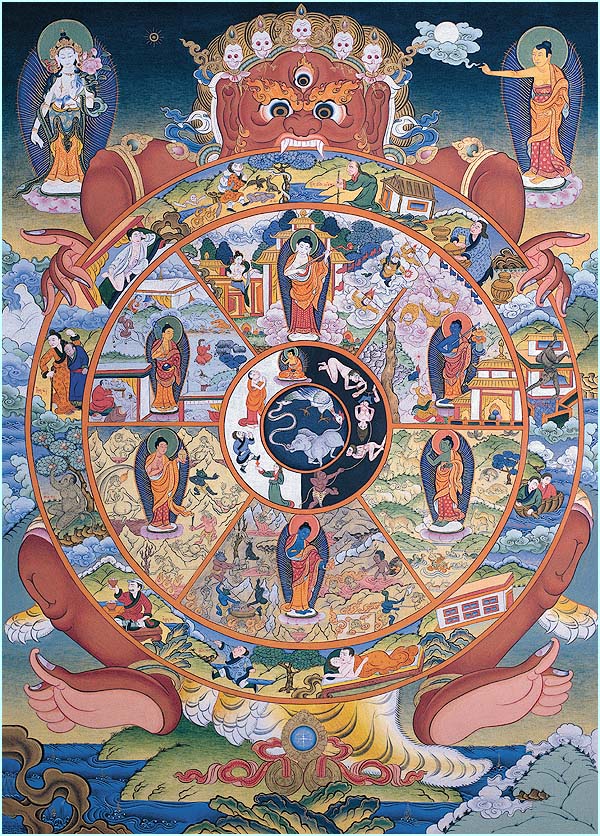
The buddhist tradition speaks of a root cause to all our suffering – basic ignorance/confusion/delusion regarding the nature of reality – giving rise to two fundamental kinds of impulses and strategies for papering over that ignorance. One is a push and the other is a pull. The former aims to get rid of whatever feels too threatening to our current sense of self, the latter aims to strengthen that sense of self by bringing in elements from the seeming outside – greater security in the form of identities, possessions, credentials, pleasures etc. (These – the three “kleshas” – are represented in the very center of the traditional Wheel of Life above.)

The two strategies deriving from ignorance get translated in a number of different ways, and those translations matter. Consider some of the alternatives for the “pull” impulse: desire, greed, attachment, passion. The English terms come preloaded with entire cultural histories, and we can’t simply forget these. For us “greed” is entirely negative, but “passion” carries a number of very positive aspects. For that matter, “attachment” and “desire” have some good senses too.

“Aggression,” “hatred,” “anger,” and “aversion” are the terms most commonly used to translate the “push” quality mentioned above. Here too there can be confusion: “aggression” is more-or-less entirely negative for us, but sometimes the word “anger” is used positively, and even “hatred” too, as when people speak about a hatred for violence or brutality, for example, or a hatred of samsara (deluded existence).

My general experience within Tibetan buddhism has been that for us humans, practically speaking, pulling isn’t considered quite as problematic as pushing, at least in general. The poetry of Trungpa Rinpoche, for example, is full of “passion,” love of human beauty and creativity, love of the earth, the elements. He was famous/notorious for his numerous affairs and prodigious drinking. He celebrated heartbreak in love and more broadly “the genuine heart of sadness,” one description of the bodhisattvic impulse itself.

Another lama put it this way: he said that even though any desire/attachment etc will cause suffering sooner or later, as beings on the path attachment has more to be said for it than aversion, specifically because it involves relationship. There is acknowledgment of connectedness, a potential for openness. Of course, this is present too in aversion – in the Tibetan view, all confused emotional energies have a flip side that is nothing other than their pure wisdom quality.

But again very generally speaking, “householder” or non-monastic buddhism recognizes a positive need for “passion” in our more usual, ordinary sense of the word. We need to generate a lot of energy for the path, to cultivate confidence, strength, and a kind of burning desire to be free of conditioning, compulsion, ignorance. As the lama mentioned above continued: even if your passion is just for an old shoe, at least you’re relating to something! There’s something concrete to work with. Whereas aversion/hatred rejects relationship itself.

And perhaps this is also why, of the six traditional psychological realms of buddhism (represented in the third spoke of the Wheel of Life), that which is associated with “desire” is the human realm, considered the most fortunate of the six. Whereas the realm dominated by aggression and hatred is of course the hell realm – the least fortunate of all.

Billie Holiday remixed, and Belfast, and Cocteau Twins…

A couple more… for it be late and sleep not yet happening. So wandering the realms of youtube, coming across a bunch of new things and revisiting some not heard for quite awhile.

Including this gorgeously sad remix of Billie Holiday by Bent:

And this one, featuring a sample from Hildegard von Bingen and a full two minutes of decelerando at the end, which always brings back a certain June night and a field near the town of Glastonbury, Somerset. 150,000 people off their heads in one form or another. Someone I love re-emerging from the shadow of the Wall. The sun slowly suffusing the eastern sky with a billion shades of orange and pink and red.

And since I happened to mention a certain combination of colors… the unspeakably sublime Cocteau Twins…

“but this world … will be shaken by a whisper”

From the exquisite album “Nommo” by Slovo, which a couple of summers ago I couldn’t stop listening to and which always sucks me in. Slovo is a project of Dave Randall’s and there have been two releases so far along with various remixes.

The vocals on this one are by Kirsty Hawkshaw, whose voice I’d heard for a long time without ever really knowing who she was, on account of those famous backward samples from Opus III on Orbital’s “Halcyon”

Some really beautiful visuals on this too.

I always think of this paired with one of their versions of “Empires Fall,” since I edited the two together for a personal compilation once. Can’t locate it at the moment, but it’s the one with just the 7/4 guitars of “Weebles Fall” and the Charlie Chaplin sample from The Great Dictator (1940) layered over it. The one that goes (and this seems somehow appropriate to quote today post-election):

I’m sorry, but I don’t want to be an emperor, that’s not my business. I don’t want to rule or conquer anyone. I should like to help everyone if possible – Jew, Gentile, black man, white. We all want to help one another; human beings are like that. We don’t want to hate and despise one another.

In this world there’s room for everyone and the good earth is rich and can provide for everyone. The way of life could be free and beautiful. But we have lost the way. Greed has poisoned men’s souls, has barricaded the world with hate, has goosestepped us into misery and bloodshed. We have developed speed but we have shut ourselves in. Our knowledge has made us cynical, and our cleverness hard and unkind.

We think too much and feel too little. More than machinery, we need humanity. More than cleverness, we need kindness and gentleness. Without these qualities life will be violent, and all will be lost. Even now my voice is reaching millions throughout the world, millions of despairing men, women, and little children, victims of a system that makes men torture, and imprison innocent people.

To those who can hear me I say: do not despair. The misery that is now upon us is but the passing of greed, the bitterness of men who fear the way of human progress, the hate of men who will pass, and dictators die. And the power they took from the people will return to the people, and so long as men die, liberty will never perish…

the Dalai Lama’s letter to President Obama

“Please accept my congratulations on your re-election to the presidency of the United States.

“When you were elected in 2008, you inspired the world with a call to take responsibility for the problems we face as global citizens. Since then, you have made earnest efforts to live up to that great hope and trust placed in you by the American public. I believe you have been re-elected now in recognition of that effort.

“When you first took office, I remember writing to you that the world places great hope in the democratic vision and leadership of the United States and that I hoped you would be able to shape a more peaceful world, bearing in mind the poverty, injustice and deprivation suffered by billions of people. The need to address these issues remains pressing today.

“As you know, it is over a year since I handed over all my political authority to the elected Tibetan leadership, but as just one among the six million Tibetans I want to thank you for your steady encouragement of our efforts to find a peaceful resolution to the problems in Tibet. I am very appreciative of your support for our Middle Way Approach, which I continue to believe is the best way for us to ensure a solution that is beneficial for both Tibetans and Chinese. Given the recently deteriorating situation in Tibet, of which the tragic series of self-immolations is a stark symptom, I hope your Administration will be able to take further steps to encourage a mutually acceptable solution.

“I am presently on a visit to Japan, and am pleased to send my prayers and good wishes for every success in your second term.”

nice one America

I feel more uplifted with regard to the election results than I assumed I would. Yes, at a federal level we have only vestigial democracy in this country. The electoral system is broken and almost totally corrupted by money, as is the federal government itself in various ways. Media discourse is deeply debased, barbaric even. The platform of one of our two major parties has gradually become more and more dogmatically and frighteningly reactionary.

And yet… I couldn’t help but be moved by the president’s victory speech last night – its graciousness, humility, inclusiveness. This man – in character and temperament, in intelligence – is probably the best we will get for a very long time. And there is some real vindication of this in the fact that he ultimately prevailed against an endless barrage, from Day One of his presidency, of not only intransigent opposition but disinformation and slander, at times crude and ugly beyond belief.

I guess what’s also contributing to this feeling is seeing the 18-29 age group increase its voting percentage this time around, which was unexpected, and the black and latina/o turnout, despite all the efforts of suppression. And of course watching our appallingly destructive “war on drugs” finally get a couple of real, solid blows. And seeing New Hampshire end up with its four-person congressional delegation, plus governor, being all women. That’s truly, truly awesome… And Obama winning even Virginia and – it looks like – Florida too.

Somehow, in spite of myself and everything I know about the state of the country and world, about how nothing has really changed congressionally or – with regard to the system as a whole – structurally, I’m kind of a little bit moved today. Note the disclaimers! – we’re a right mess, no doubt about it. We don’t recognize the reality of complete interdependence, and because of this we get everything – to one degree or another – wrong. We can’t (yet) see our way through to a world without scapegoats and enemies, beyond war mentality.

Obama too is not free of this vision, not free of imperfections in judgment and policy. But I appreciate his gentleness and thoughtfulness, his genuine respect for others and openness to different perspectives, and his extraordinary calm, qualities positively required in his job these days as we look towards a number of exceptional challenges.

Nobody should have the amount of responsibility on their shoulders that he has. But since it seems that he does, I can only hope that more and more of those who over the past four years have sought nothing other than to tear him down, regardless of the cost, will recognize how much of a moderate the president truly is. His heart, I believe, is progressive, but by temperament and style he is rather conservative, and this is actually a pretty ideal combo in a US president for these times.

Maybe, just maybe, this election result can bring about a little less rigidity of view. I know I know, hard to imagine these days. But I think most people really long for that. With just a bit of non-partisan, good-faith support, some fine things could yet be accomplished.

Sandy (2)

(continued from below)

And the results of that unfolding can only be experienced elementally. Earth yields and collapses, water expands and engulfs, heat/fire is generated and consumes, wind overpowers and destroys. Living through an actual earthquake we suddenly remember earth, real earth, not the chemical composition of soil. Maneuvering through turbulent sea or sky we remember, in our bones and blood – not “H2O” but real water, not a mere list of gases with approximate compositional percentages but real air. Our very emotions, kinds of insight, styles of personality, along with all our bodily processes, correlate remarkably beautifully and profoundly with these fundamental qualities of energy – symbolized for example by the five colors of Tibetan prayer flags.

The entirety of taoist practice and Chinese medicine, too, emerges out of elemental sacred vision and experience – again five energies, as it happens, though seen and worked with in somewhat different ways from the Indo-Tibetan. I know very little about other systems than these but enough to say that wisdom traditions in every continent seem to have arisen out of this kind of awareness.

By contrast, what does a purely scientific – that is, fundamentally conceptual and analytic – way of understanding what is “elemental” have to tell us about ourselves? About how we actually experience our lives, day to day, moment to moment? Copper, phosphorus, bromine, praseodymium: these truly are abstractions utterly disconnected from our bodily human reality. They take their places within an elegant and revelatory periodic table, yielding crisp, pristine, purposeful answers to a multitude of material concerns. And at the same time … they have nothing to say to us as we meet, personally, the phenomena of our inner lives in every instant.

I’m as much a product of my times as anyone and I’ve been experiencing Sandy, yes, as a rational phenomenon that can be “explained” via translation into meteorological language. But at the same time … there has been something, no not sentient, but in any event truly, fully alive taking place in “her.”

Today while walking, for instance, I couldn’t help but sense the closer presence of the storm. Vastly weakened from its peak, it is now passing about as close to us here as it will, and somehow this truth registered despite mostly gorgeous mild weather this last day of October. It announced itself in astonishing cloud formations and in the smell of the air, a sense of something mighty, commanding complete respect, having been discharged, of release and decline. Of the return to harmony after so monumental a display of power. Uneasy reprieve (those clouds belonging, after all, to the very same system that pulverized NJ and NYC), a feeling of some giant gliding past, all of us tip-toeing and holding our breaths as it were, hoping to avoid notice, lest maybe this Sandy character might change its mind and decide to go out, after all, with just one more bang…

a thought on Sandy

Ultra-clever apes as we can be, we “developed” Westerners have seen fit to banish all elemental/energetic understanding from our universe. All “ordinary magic,” all sacredness.

We “know” that earth, water, fire, and air are not “real” elements but rather incoherent, primitive categories of “developing,” pre-scientific cultures. We know that there is only one possible way of understanding the elemental: conceptually, via thoroughgoing analysis. In fact, really, we can’t any longer conceive that there could be an alternative mode of seeing.

We know that the universe is really made up of Hydrogen, Helium, Lithium and so on, all the way up to … Flerovium and Livermorium now, it looks like. It never occurs to us that these too are actually human creations, abstractions. Except we also know that at the sub-atomic level all that solidity breaks down in very peculiar ways difficult to conceptualize. In fact at that point it all looks rather like what the buddhists call space – their fifth element, the non-material one of accommodation/complete openness which makes all form and phenomena possible. Which makes all combinations of the other four possible.

And yet, how interesting it is that for example we also give our hurricanes names. Human, mortal names, as befits a would-be democratic age, but names all the same. How is this so very different from the practice of cultures all over the world in naming deities of Ocean, Thunder, Fire, particular territories of the earth, the animating spirits of individual animals or plants? We no longer say Briareos but rather Sandy or Irene, but the impulse is the same, isn’t it?

The objection of course will be: ah but we don’t actually believe there’s a sentient being in there somewhere, animating that storm with purpose. This is true, but also not quite the point.

An energetic or sacred understanding of reality is not at all antagonistic to a scientific one as such. The two modes of perception simply operate in different registers, different realms in a sense. Side by side with all the explanations of why this storm was so unprecedented and powerful, with the hourly projections concerning trajectories, timing, wind speeds, rainfall, surge heights, another form of experience could yet be sensed within the discourse, dimly but unmistakeably. Underpinning the assumption of pure rationality lay, in fact, an attitude of awe, and fundamental incomprehension. Something like the “beginner’s mind” of Zen.

With all of our knowledges, we will never capture a storm in the pure abstraction of concept. We know, too, that we cannot master a storm. We may split atoms in a kind of ultimate display of techno-analysis, but even the terrifyingly murderous weapons that can be produced from such cleverness are still no match for an “entity,” that is to say a process, like Sandy. So we may only sit, and watch, and wait, as something far bigger than what our comprehension can encompass … unfolds. In its own sweet time.

(to be continued)

Facebook vs. friends? (2)

More from the same essay:

Friendship is devolving, in other words, from a relationship to a feeling—from something people share to something each of us hugs privately to ourselves in the loneliness of our electronic caves, rearranging the tokens of connection like a lonely child playing with dolls. The same path was long ago trodden by community. As the traditional face-to-face community disappeared, we held on to what we had lost—the closeness, the rootedness—by clinging to the word, no matter how much we had to water down its meaning. Now we speak of the Jewish “community” and the medical “community” and the “community” of readers, even though none of them actually is one. What we have, instead of community, is, if we’re lucky, a “sense” of community—the feeling without the structure; a private emotion, not a collective experience.

So information replaces experience, as it has throughout our culture. But when I think about my friends, what makes them who they are, and why I love them, it is not the names of their siblings that come to mind, or their fear of spiders. It is their qualities of character. This one’s emotional generosity, that one’s moral seriousness, the dark humor of a third. Yet even those are just descriptions, and no more specify the individuals uniquely than to say that one has red hair, another is tall. To understand what they really look like, you would have to see a picture. And to understand who they really are, you would have to hear about the things they’ve done. Character, revealed through action: the two eternal elements of narrative. In order to know people, you have to listen to their stories.

But that is precisely what the Facebook page does not leave room for, or 500 friends, time for. Literally does not leave room for. E-mail, with its rapid-fire etiquette and scrolling format, already trimmed the letter down to a certain acceptable maximum, perhaps a thousand words. Now, with Facebook, the box is shrinking even more, leaving perhaps a third of that length as the conventional limit for a message, far less for a comment. (And we all know the deal on Twitter.) The 10-page missive has gone the way of the buggy whip, soon to be followed, it seems, by the three-hour conversation. Each evolved as a space for telling stories, an act that cannot usefully be accomplished in much less.

Facebook vs. friends?

Being just about the only person I know who isn’t on Facebook, I was interested in this essay by William Deresiewicz about human connection in the Age of the Twitterati. Some samples:

Facebook’s very premise—and promise—is that it makes our friendship circles visible. There they are, my friends, all in the same place. Except, of course, they’re not in the same place, or, rather, they’re not my friends. They’re simulacra of my friends, little dehydrated packets of images and information, no more my friends than a set of baseball cards is the New York Mets.

…Facebook seduces us, however, into exactly that illusion, inviting us to believe that by assembling a list, we have conjured a group. Visual juxtaposition creates the mirage of emotional proximity. “It’s like they’re all having a conversation,” a woman I know once said about her Facebook page… “Except they’re not.”

Until a few years ago, you could share your thoughts with only one friend at a time (on the phone, say), or maybe with a small group, later, in person. And when you did, you were talking to specific people, and you tailored what you said, and how you said it, to who they were—their interests, their personalities, most of all, your degree of mutual intimacy… Now we’re just broadcasting our stream of consciousness, live from Central Park, to all 500 of our friends at once, hoping that someone, anyone, will confirm our existence by answering back. We haven’t just stopped talking to our friends as individuals, at such moments, we have stopped thinking of them as individuals. We have turned them into an indiscriminate mass, a kind of audience or faceless public. We address ourselves not to a circle, but to a cloud.

Of course, there’s no necessary mutual exclusivity here, but I do wonder to what extent the one form of communication is crowding out the other. More later.

Bonobo – Nightlite (featuring Bajka)

Sitting in a cafe where this has come on, reminding me how much I’ve always liked what Bonobo (a guy called Simon Green) does. The strings in this one really make it for me, adding that extra twist of drizzly-late-autumn-afternoon-melancholy to the gentle swing of the tune.


the genius of Andy Partridge

Gold sun rolls around
Chocolate nipple brown
Tumble from your arms
Like the ground your breasts swell
And awake from sleep
Hares will kick and leap
Flowers climb erect
Smiling from the moist kiss of her rainbow mouth

Simply one of the finest songwriters around, and far too unknown in the US. Something amazing started blossoming in this guy’s head in the mid-80s and the albums beginning at around The Big Express and Skylarking and moving on through Oranges and Lemons, Nonsuch, and Apple Venus Volume 1 contain many gorgeously-crafted creations.

This is one of a dozen or so of theirs that gives me chills everytime. Andy himself says in this very entertaining, hour-plus-long interview that it’s maybe one of two favorite songs of his (the other being “Wrapped in Grey”). He’d come up with the chorus many years before but didn’t do anything with it – it just sat there in the recesses of his unconscious waiting for something. Then one day he found himself playing with these “earthen, lumpen” (as he puts it) chords on his guitar (which end up being orchestrated). They kept rising up the strings until there was nowhere left for them to go and then suddenly … that melody from a decade or more earlier leapt out, and “Easter Theatre” was born.

With no false modesty (entirely appropriately) he says in the interview that sometimes you wonder if you might ever reach the heights of the greatest songs you ever heard (he mentions the best of the Beatles at that point), and that when this one was finished he realized he’d got there:

You know you’re doing alright if at some point during recording a demo, your hair stands on end. Which it did when I reached the ‘Easter. . . in her bonnet’ section in the middle. Self fright or self delight is difficult to achieve at the best of times, but here, bang out of nowhere, it arrived in bucket loads. Every pore of my skin was smiling fit to burst. Where does this stuff come from? Surely it’s not me thinking these songs up? I live in Swindon! Maybe my right arm is an aerial picking up the practical jokes of angels or the whisperings of Genii. Surely my washing machine motor of a secondary modern school brain isn’t capable of thinking up songs like this?

(Stage left)
Enter Easter and she’s dressed in yellow yolk
(Stage right)
Now the son has died, the father can be born
(Stand up)
If we’d all breathe in and blow away the smoke
(New life)
We’d applaud her new life