the Karmapa on gender (2)

Continuing on from the preceding post, two more exhilarating moments from The Heart Is Noble: Changing the World from the Inside Out:

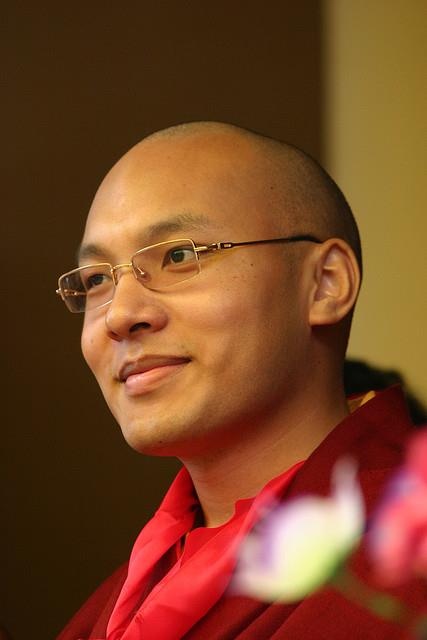
As for myself, I am a Khampa, but I do not like to take an aggressive stance or oppose others at all. People who watch out for my interests sometimes advise me to be less earnest and to go on the offensive more. They caution me against being so open and trusting. They warn me that people can have all sorts of different motivations and ulterior motives, and may be out to deceive me or use my name for their own ends. Even though I have heard this advice clearly, I cannot change. Actually, I don’t want to.

17th-karmapa

In this era of global communication and weapons of mass destruction, rather than impose our will on others by force, we urgently need to find ways to accommodate divergent wills. It has been a long and gradual process, but I believe the world is slowly coming to realize that what we need now is not the ability to make assertions, but the ability to listen. Especially with the unthinkably destructive power of the weapons we have at our disposal, it seems clear that we need to sit down to dialogue, and not stand up to fight.

The times call on us to look at others with the attentive and loving eyes of a mother, rather than with the hostile eyes of a warrior in battle. If we are going to divide up qualities as masculine or feminine, I think we have to say that the qualities we need today are qualities more often described as feminine. We need communication and sensitive listening to others’ needs – qualities that are likelier to be identified as feminine than masculine in most societies.

It is time we truly recognize that the era of the hunter is past. This should be a more “feminine” era…

the Karmapa on gender

The previous post here talked a bit about the Karmapa’s new book The Heart Is Noble: Changing the World from the Inside Out. The chapter I find the most remarkable of all has to be the one on gender – “Gender Identities: It’s All in the Mind.” This is so because Tibetan culture, as is true of traditional cultures in general all over the world, has maintained a strongly gendered view of psychology and society.

Nothing in this chapter hasn’t been said by various western teachers of buddhism, and stray remarks can be found – increasingly so in recent decades – coming from other Tibetans, but this chapter surely represents the most direct and sustained presentation of the emptiness of gender from within the Tibetan world. As such I feel it to be a genuinely epochal moment.

A couple of examples:

Gender identities permeate so much of our experience that it is easy to forget that they are just ideas – ideas created to categorize human beings. Nevertheless, the categories of masculine and feminine are often treated as if they were eternal truths. But they are not. They have no objective reality. Because gender is a concept, it is a product of our mind – and has no absolute existence that is separate from the mind that conceives of it.

tumblr_mc9t4g07YY1r4p4ago1_500

(©bodhiimages — Tim Buckley)

Societies take the distinction between masculine and feminine qualities very seriously indeed. Whole industries reinforce gender ideals, such as, for example, boys should be brave and girls should be sensitive. Society promotes the idea that people with Y chromosomes should exhibit only “masculine qualities,” and people with X chromosomes should exhibit “feminine qualities.” This holds us back, limiting men and women to socially constructed boxes, and causing a great deal of suffering for everyone [my emphasis].

In my own personal case, I do not always feel clear about this distinction between masculine and feminine qualities. People have told me that I have more feminine qualities than masculine. I do not know quite what that means. I have a sense of what these qualities feel like, but I have no labels of “feminine” or “masculine” to go with the feelings. I simply experience them.

For me personally, knowing how to define and categorize such things is not important. What matters to me is being able to connect with others heart to heart, with real feeling. What I value is the ability to speak from my heart, and to be tender and caring. I hope I have some of these qualities. Certainly these are the qualities I aspire to have. It does not strike me as at all relevant whether they are categorized as feminine or masculine.


21st-century lama

I’m very grateful for the new book by the 17th Karmapa, The Heart Is Noble: Changing the World from the Inside Out.

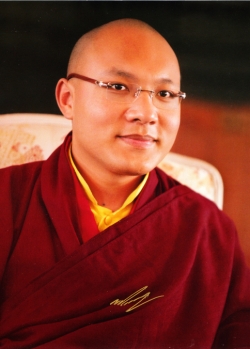
draft_lens9962341module89685641photo_126849083917Karmapa_Ogyen_Trinley.j

I first became aware of him via his “Aspiration for the World“. Not long after, he issued an edict mandating vegetarianism in all centres within the Kagyu lineage – of which he is the head. (Many people assume buddhism to require vegetarianism of its practitioners, but this isn’t so, particularly within Tibetan buddhism.) These statements appeared when he was twenty or so, around 2006.

The Karmapa lineage is one of the oldest reincarnating lineages within Tibetan buddhism, older than the Dalai Lamas by a couple of centuries, and the current Karmapa’s immediate predecessor – the 16th – was one of the most revered buddhist teachers of modern times.

So, I began to take note of him. However, honestly it had been some time since I’d been able to feel hopeful about institutional Tibetan buddhism. Long story, but suffice it to say, for those lacking experience in this area, that power does seem to corrupt everywhere, and the greater the power, the greater the danger of this. So even a certain amount of despair had set in with me regarding the question. (Cf. even the Karmapa controversy itself, there being two rivals – though all of the lamas whose teachings I’m acquainted with, including the Dalai Lama, recognize this one, whose name is Ogyen Trinley Dorje.)

I must say, though, that this book truly heartens me. I feel that with the 17th Karmapa we have our first fully 21st-century lama. Have a look at some of the chapter titles: “Social Action: Caring for All”; “Environmental Protection: Cultivating New Feelings for the Earth”; “Food Justice: Healing the Cycles of Hunger and Harm”; and, most startlingly from a Tibetan teacher, “Gender Identities: It’s All in the Mind.”

Of course, it’s not a political book, reaching far deeper, but the point is that the Karmapa represents the first Tibetan lineage holder I’ve come across whose mind seems fully at home in the ecological View, who sees our predicament and understands that there is no room anymore for any kind of duality between personal practice and practice for our Earth and for the world.

The talks in this book in fact came out of meetings with American college students. It’s funny to remember too: back in 2006 I participated in a week-long program with the great Tsoknyi Rinpoche, and one of the things he said in one of the question-and-answer sessions was that powerful teachers manifest and develop in particular ways in the world in part due to our aspirations, so that if, for example, we yearn hard enough for “an ecology buddha” (his words), someone who will be of special benefit in this way, we might get one. And it was around this time, in fact, that the 17th Karmapa began to come into his own distinctive voice as it were.

I remember hearing somewhere also that Thrangu Rinpoche, his personal tutor, said of him around this time that he’d thoroughly mastered everything he had to teach him. And within Tibetan buddhism this is an extraordinary thing to say of someone of that age, given the immensity and depth of philosophical learning on the one hand, and actual practices on the other.

My feeling, and that of many others, is that the 17th Karmapa may well become a world leader in the decades to come, comparable to the Dalai Lama today. Judging by this book, which I am about halfway through now, he has much to say that we desperately need to hear and work with.

love to you, Richie Havens

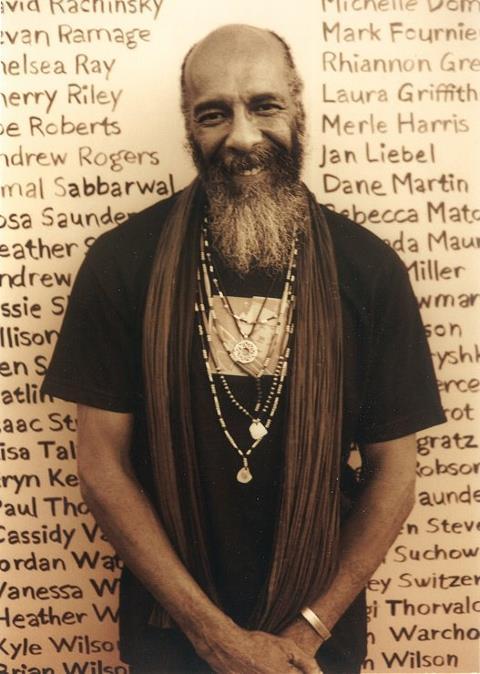
richie-havens

We lost a beautiful man today, very suddenly.

I first came across him when I saw the movie Woodstock, at which festival he was the (then little-known) opening act. Since there turned out to be a delay of a couple of hours before the next band was able to arrive, he kept being sent out to sing a few more songs, and at a certain point, so the story goes, he had played everything he knew. So then he launched into an improvised version of the old spiritual “Motherless Child,” which became “Freedom” – one of the iconic moments of the festival and perhaps of the ’60s as well.

But it was only some time after seeing the film that I heard a song of his that really touched me. It’s called “You’ll Never Know” and there’s something so perfect and profound about it. I was hoping to link to it but YouTube is turning up nothing, alas, and I’m not able to upload my copy, for now anyway.

In any event, not long after coming across that song I noticed that he was playing my town – this was just a few years ago – and earlier in the day I hung out in the local Borders listening to him sing and chat with people. So many people have spoken about his kindness and gentleness, and I can add my little encounter to this also. I decided to buy a copy of his recent CD, which turns out to have been the last he released, and talked with him for a few minutes. The photo above really captures my memory of him that afternoon and later at the concert. A huge heart, full of love for the world.

I like this photo of him also, seemingly startling Sean Penn at the 61st Cannes Film Festival:
Richie Havens - Sean Penn

And this one, with Michael Wadleigh, the director of Woodstock (who turns out also to be a Harvard professor, with degrees in physics and medicine – who woulda thought?):
Richie+Havens+Michael+Wadleigh+Woodstock+40th+-_NSwoDrSmRx

So he signed my CD and I took it away, only remembering to look at it after I’d returned home. And think about this: what do people write on occasions like that? It’s usually simply their name, or “to So-and-so,” or something like “all the best,” right? But he chose … really, when I think about it, the most beautiful message possible … to give to people, to these “strangers” coming up to him, and in our cynical age probably most will not believe me when I say: if you’d been there and seen and heard him interact with everyone, he truly meant it, however many hundreds or thousands of times it was written. It was the bodhisattva in him, making a connection. Underneath the lyrics to “The Key” (see below), he’d written: To Paul, a friend forever.

The best of journeys, friend.

George Saunders walks us through his desktop

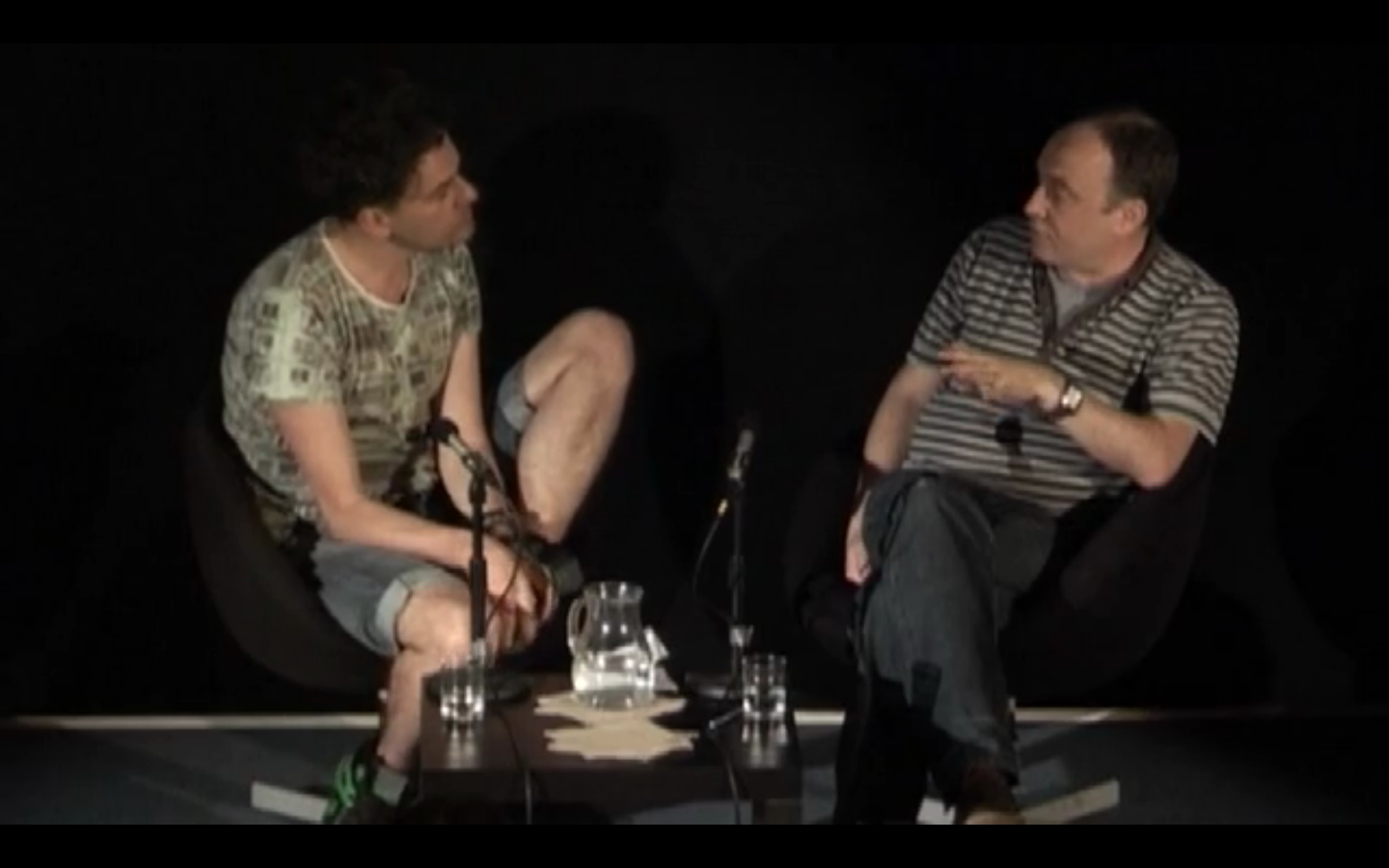
Just back from a Q-and-A with Junot Díaz, about which hopefully more later. Looking something up about him, I was led just now via the ultimately unfathomable logic of hypertextuality here, to a Guardian series on writers’ desktops, wherein, it seems, they basically sit in front of their computers and comment on the icons, folders, photos etc they see… This one, published today, features George Saunders, and I liked this bit:

I’m not easily distracted, as a rule. Especially where writing is concerned. But I have noticed, over the last few years, the very real (what feels like) neurological effect of the computer and the iPhone and texting and so on – it feels like I’ve re-programmed myself to become discontent with whatever I’m doing faster. So I’m trying to work against this by checking emails less often, etc etc. It’s a little scary, actually, to observe oneself getting more and more skittish, attention-wise….

I do know that I started noticing a change in my own reading habits – I’d get online and look up and 40 minutes would have gone by, and my reading time for the night would have been pissed away, and all I would have learned was that, you know, a certain celebrity had lived in her car awhile, or that a cat had dialled 911. So I had to start watching that more carefully. But it’s interesting because (1) this tendency does seem to alter brain function and (2) through some demonic cause-and-effect, our technology is exactly situated to exploit the crappier angles of our nature: gossip, self-promotion, snarky curiosity. It’s almost as if totalitarianism thought better of the jackboots and decided to go another way: smoother, more flattering – and impossible to resist.

And this:

“InfanView” is an app that produces a list of all babies born in your area, ranks them for cuteness, and auto-sends each one a Facebook Friend request on your behalf. It’s good for building up one’s “fan base.” Ha. No – I think it’s “IrfanView“, and I honestly have no idea what the hell it is. I just went in and opened it and still have no idea. It’s a relic of something, but I don’t know what.

New Zealand sings a love song

And despite myself I am moved, actually…

As spotted on The Dish, after the vote for marriage equality was announced in the New Zealand parliament today, the chamber erupted in applause, and then all the members of the packed gallery suddenly turned themselves into a chorus, belting out the old Maori love song Pokarekare Ana, as the presumed sponsor of the bill joyfully hugged all her supporters.

Why do I say “despite myself?” Well, while some form of civil union should of course, as an urgent matter of humanity, be available to all couples whatever their gendered configuration, the battles specifically surrounding marriage haven’t been ones I can muster a lot of passion about.

This is so for several reasons about which I may write another time. But all that aside: a beautiful moment down there in Middle-Earth…

“Oh my beloved, come back to me, my heart is breaking for love of you…”

(exceptionally) minor revelation – plus Stravinsky conducts!

For some reason I have only just today realized why it is that some car horns sound more unpleasant/aggressive than others. I had this realization upon accidentally pressing my honking lock button (I prefer to manually lock) just before hearing someone else honking on the street.

I’d never really paid attention, always merely stopping at the perception: unpleasant, please stop. (Particularly when directed – unjustly – at me…) It never occurred to me that, of course, somebody has to program those sounds, and when you actually listen to them, some are in fact less harmonious than others.

To wit, my own car sounds a fairly clean major triad, second inversion, trumpet-like and mf to f. Others have more dissonance in the harmonics, sounding like a trio of dyspeptic out-of-tune trombones, perhaps, and ff, at a minimum.

So now I have my answer: certain car companies hire less musical horn programmers than others. (Or am I imagining all this?)

I still want a horn with a cool ring tone.

Not ugly MIDI phone ring tone, but an actual sample. Like how about the horns at the stupendous end of The Firebird (at 6:07 below)? A short honk could include the first 6 chords, but then if you held it down longer you’d get the full 13 chords (with or without concluding timpani!). Why not? Make someone smile/laugh while they get alerted.

And amazingly – where do people find these things? – a video exists of Maestro Stravinsky conducting this himself. And what a performance! (Interesting how very short he took the chords at 6:35 – which I’m not used to. However, he is The Boss so…)

What an ovation too. Not sure I’ve heard one like that before.

Peter Gabriel – San Jacinto (New Blood version), live in London HD

A year or so ago Peter Gabriel released New Blood in which he reworked a group of his songs for orchestra and voice alone. I’d heard the version of Mercy Street awhile back – very beautiful, of course, though I’m just not sure anything could improve on the original (and that link also another exception to the rule that music videos – this one directed by Matt Mahurin – detract from the power of the music).

Then last night I came across the new version of San Jacinto and … well, what to say? It’s one of the greatest vocal performances I’ve seen in quite awhile, spine-chilling, perfect. The orchestra frames his voice in such a way that the rawness and depth of the song can come fully through. And I’m not sure he’s ever sung better, honestly. Well, just watch. And then, when you’ve recovered, you will probably want to rewind…

on “measuring” “sexuality”

May as well try to “measure” music in order to say it’s one “thing” or the “other.”

Music, of course, has multiple layers/dimensions – four major ones: rhythm; melody (to one degree or another); timbre; and (in all but monophonic music) harmony. (Each of these in turn are multi-layered: melody can be contrapuntal to any degree of complexity, timbral possibilities are infinite, and so on.) We can’t simply take and reduce it as a phenomenon to just one of those, then reduce that to a choice of two dots.

Of course, that’s what Stalin’s cultural goons did, according, apparently, to Shostakovich: they at one point started counting the number of major and minor harmonies in a piece, and those whose ratio was too skewed to the minor got their composer condemned for insufficient revolutionary joy!

But of course even harmonies can’t be reduced to two. They exist within larger systems of key. And then, even major and minor keys are only two of seven traditional Western modes. The music of other cultures encompasses a great variety of modes also, including microtonal ones. And then of course there is modulation into other keys, and atonality too: neither major nor minor nor modal in any other way.

Sexuality, like music, is multi-dimensional. Immeasurable.

However, these days we have become so locked within an extraordinary – not to mention extraordinarily dogmatic – paradigm that it is almost impossible even to discuss “sexuality” in the true, vast meaning of the word. For various historical and cultural reasons, our vision has become utterly one-pointed, and grotesquely disfigured, in this regard.

And just how much pounding on square pegs to get them to fit into round holes thus has to go on can be demonstrated every single day with new material. Today, for example, there is this report on Andrew Sullivan’s blog, beginning: “We’re slowly getting a sense of how many TGBQLX people there are in America. I.e. how many homosexuals, lesbians and transgenders there are in the population.”

That “i.e.” is revealing. What comes after an “i.e.” of course is meant to be a definition or exemplification of its antecedent, so here Sullivan is saying the following: 1) transgender identity is practically speaking congruent with “sexual orientation,” like the “L” and “G” categories. He makes this clear by the next sentence: “When I was a newbie gay, the mantra was 10 percent.” But of course when he “was a newbie gay,” that meaningless 10 percent figure was meant to relate just to the categories of “L” and “G.” People weren’t talking about the other ones.

And 2) we can simply ignore the “B’s,” “Q’s,” and “X’s,” because they too are really the same basic “thing” as the “L’s and G’s” (and, of course, “T’s”).

So, all the usual problems apply. Firstly, those who identify as trans have innumerable “sexual orientations,” and these are not possible to map onto the ones we have: if one biological male becomes a woman and then invests her sexual life exclusively (for the sake of simplicity) with men, clearly she is in not the same but the very opposite category of “sexual orientation” as the biological male who becomes a woman and then invests her sexual life exclusively with women. One of those two categories has to be considered – according to the logic we have harnessed ourselves to – as precisely “straight.” In other words, transgender simply can’t be used to bolster figures of “sexual orientation.” At all.

Secondly, the categories “Q” (by which is usually meant “queer,” an explicit rejection of the system as a whole), and “X,” which I’ve never seen before in this context but which can only be referring to something like “none of the above,” actually have nothing logically to do with the idea of “G” and “L.” But if one wishes to think that they (along with “B” of course) are really just variants on “L” and “G,” then of course the former can, and practically speaking are, more or less always ignored.

They’re even mentioned at all, in that case, so that wishful thinking and a desire for hygienic, stable, absolute categories can feel as if it is being true to “diversity,” while at the same time resolutely closing its eyes to it at every turn.

For it is precisely those “B’s,” “Q’s,” and “X’s” – amongst many other phenomena internally contradictory within our constructs of “gay” and “straight” themselves – which reveal the instability of our contemporary regime of “sexuality.”

In a time when the category of race has finally come to be understood – by more and more at least – as ultimately incoherent, that of something we are calling “sexuality” gets more reified, reductionistic, and rigid every year.

And of course there are a number of cultural reasons for this, about which … much more over time!

Ned Rorem on Leonard Bernstein

This likewise from Other Entertainment – “Lenny Is Dead” (October 1990).

During the terrible hours following Lenny’s death last Sunday the phone rang incessantly. Friend after friend called to commiserate, and also the press, with a flood of irrelevant questions: How well did you know him? What made him so American? Did he smoke himself to death? Wasn’t he too young to die? What was he really like? None of this seemed to matter since the world had suddenly grown empty – the most crucial musician of our time had vanished. But next morning it seemed clear that there are no irrelevant questions, and these were as good as any to set off a brief remembrance.

How well did I know him? To “know well” has to do with intensity more than with habit. Everyone in Lenny’s vast entourage felt themselves to be, at one time or another, the sole love of his life, and I was no exception. The fact that he not only championed my music, but conducted it in a manner coinciding with my very heartbeat, was naturally not unrelated to love. Years could pass without our meeting, then for weeks we’d be inseparable. During these periods he would play as hard as he worked, with a power of concentration as acute for orgies as for oratorios. In Milan, in 1954, when he was preparing La Sonnambula for La Scala, I asked him how Callas was to deal with. “Well, she knows what she wants and gets it, but since she’s always right, this wastes no time. She’s never temperamental or unkind during rehearsal – she saves that for parties.” Lenny was the same: socially exasperating, even cruel with his manipulative narcissism (but only with peers, not with unprotected underlings), generous to a fault with his professional sanctioning of what he believed in.

Was he indeed so American? He was the sum of his contradictions. His most significant identity was that of jack-of-all-trades (which the French aptly call l’homme orchestre), surely a European trait; while Americans have always been specialists. … Yes, he was frustrated at forever being “accused” of spreading himself thin, but this very spreading, like the frustration itself, defined his theatrical nature. Had he concentrated on but one of his gifts, that gift would have shriveled.

Was he too young to die? What is too young? Lenny led four lives in one, so he was not 72 years old but 288. Was he, as so many have meanly claimed, paying for the rough life he led? As he lived many lives, so he died many deaths. Smoking may have been one cause, but so was overwork, and especially sorrow at a world he so longed to change but which remained as philistine and foolish as before. Which may ultimately be the brokenhearted reason any artist dies. Or any person.

So what was he really like? Lenny was like everyone else, only more so. But nobody else was like him.

Ned Rorem on Ravel and Debussy

Have been browsing through one of Ned Rorem’s collections, Other Entertainment. This is from a very brief piece on Ravel and Debussy:

Ravel and Debussy, the mother and father of modern French music, were so alike in esthetic and vocabulary that it’s become fashionable to claim how different they were. In fact, the differences are superficial: like Comedy and Tragedy they are two sides of the Impressionist mask. Good musicians of the same generation often come in pairs wherein both speak one language, but with divergent accents – of optimism and pessimism, for instance, or of concert hall versus opera stage. Witness Mozart and Haydn, Mahler and Strauss, Copland and Thomson, Britten and Tippett, Poulenc and Honegger.

In formal matters everyone agrees that Ravel was a classicist, Debussy a free versifier. Yet the orchestral masterpiece of each one proves the reverse. Ravel’s Daphnis is a loose rhapsody, Debussy’s La Mer a tight symphony. Melodically Debussy was short of breath, like Beethoven, while Ravel spun out tunes that were minutes long, like Puccini. Contrapuntally they were, like all the French, unconcerned. Rhythmically they were, like all the French (because of the unstressed national speech from which their music springs), generally amorphous. Harmonically they dealt in the same material of secondary sevenths, except for the whole-tone scale, which Ravel avoided. And coloristically they both excelled, making rainbows from a lean palette. Their game could be called Sound, sound taking precedence over shape, over language.

Mark Cousins interview at Watershed

And speaking of The Story of Film, there’s an interview with Mark Cousins here about the series at the Watershed in Bristol (a place I used to live down the road from). Cousins’s passion for the cinema really comes across.

Screen shot 2013-02-03 at 12.47.42 PM

One nice moment:

I’m really interested in this idea of how you build an appetite for something. When I was writing the book of The Story of Film, I was desperate to see this Ethiopian film – Harvest: 3,000 Years. It took me about two months, and $170, to get my hands on this. And now it’s literally a click away. So I think the longing for cinema, the desire for cinema – you know it’s similar to eros in some way – people don’t need to long for it in the way that they did previously, so there’s not that difficulty anymore….

I first heard about Citizen Kane nine years before I could get to see it, so that was nine years of expectation and imagination. And boy does that add something. There’s a kind of suspense in that, you know. So that’s gone. But something else has replaced it, which is a kind of ultra-availability, and that has its own pleasures and its rewards. And you can sort of binge in a way that you couldn’t previously.

So I think just the culture has changed, and what the role – I don’t need to tell you this, because Watershed is such a beacon for this kind of thing – but the role of Watershed and places like this is to put on Carl Theodor Dreyer films at lunchtime, which you’ve done – beautiful idea – and say to people: look at this splendid thing. And the fact that Adrian can do a score for one of the greatest films ever made, The Passion of Joan of Arc. This is a way of saying to people, within all that blurry, overwhelming, smorgasbord plenitude of what’s out there: look at this thing, look how splendid it is.

That’s why we’ve got Lars von Trier in here saying: Dreyer is the greatest. Trier says Dreyer’s films are like a good soup when you boil them down and down to their essence, which is a lovely way of putting it.

And I think I’m quite an optimist about people and audiences. People want enriching experiences and they want connective tissue. And they want to go away from a lunchtime screening, having felt: wow, I saw something – that lovely phrase that Fenner Brockway, the politician, said: see the flame and go towards it. That’s what people want, you know. But there’s lots of stuff and noise in the way, cultural noise.

Mark Cousins – The Story of Film

It’s a 15-part, 15-hour documentary on the entire history of film, and very enjoyable.

Easy to take apart this kind of project. Are Cousins’s choices idiosyncratic in places? Of course – but how could they not be? Is any individual person going to agree with each of his sentences that begins “this is the greatest x, y, or z in the history of film”? Obviously not. Will some people find him insufficiently theoretical, or whatever else? No doubt.

“The story of film” is going to be a subjective one no matter who is telling it, and Cousins doesn’t try to pretend otherwise. What you find in this series is a very nicely organized narrative touching upon (necessarily briefly) an enormous range of highlights in the history of cinema. Each episode averages 35 or 40 or so clips (a list can be found here), and on the whole they are beautifully chosen. Cousins also often juxtaposes two scenes from quite different times and places as visual echoes – sometimes explicit inspirations for the director under discussion, sometimes not.

One of the crucial choices for the series – and the book which preceded it – was to re-orientate our usual focus upon Hollywood and American film more generally. Instead, Cousins spends greater time than is the norm on other continents – with East Asian, Latin American, African, Iranian film. So I am guessing the series will provide at least a few discoveries for all but the more widely-travelled filmgoer.

(from Wikipedia)
Episode 1. Introduction; 1895-1918: The World Discovers a New Artform; Thrill Becomes Story
Episode 2. 1918-1928: The Triumph of American Film…; …And the First of Its Rebels
Episode 3. 1918-1935: The Great Rebel Filmmakers Around the World
Episode 4. The 1930s: The Great American Movie Genres…; …And the Brilliance of European Film
Episode 5. 1939-1952: The Devastation of War…and a New Movie Language
Episode 6. 1953-1957: The Swollen Story: World Cinema Bursting at the Seams
Episode 7. 1957-1964: The Shock of the New – Modern Filmmaking in Western Europe
Episode 8. 1965-1969: New Waves Sweep Around the World
Episode 9. 1967-1979: New American Cinema
Episode 10. 1969-1979: Radical Directors in the 70s Make State of the Nation Movies
Episode 11. 1970s and Onwards: Innovation in Popular Culture Around the World
Episode 12. The 1980s: Moviemaking and Protest Around the World
Episode 13. 1990-1998: The Last Days of Celluloid Before the Coming of Digital
Episode 14. The 1990s: The First Days of Digital – Reality Losing Its Realness in America and Australia
Episode 15. 2000 Onwards: Film Moves Full Circle – and the Future of Movies; Epilogue: The Year 2046

I’ve only just begun watching it and will probably say more over time. Am skipping around for some reason – have so far seen episodes 1, 3, 8, 10, and 13.

scientism: 3) the syndrome

In a previous post I tried to delineate the nature of a particular syndrome, one which is rarely aired outside of Science Studies, STS (Science, Technology, and Society) and other academic departments. In beginning to write about this I’m reminded of a quotation I just came across from Bill McKibben, in an interview publicizing the Burlington Book Festival:

Books remain the single most important way for societies to think seriously about themselves. There are arguments that can only be made at length, and with grace, which is to say only with books.

This certainly holds true with regard to the subject at hand. It’s exceptionally hard, in a short statement, to say anything about it that is perhaps worth saying. Nevertheless, I would like to throw out a provisional set of arguments over a series of posts. As we find ourselves moving further and further down a path whose deeper premises remain effectively unquestioned, I believe this topic can only acquire ever more importance.

I will be suggesting ten or so reasons why such questioning needs to be taken more seriously. Most of these points are not particularly controversial. Nevertheless, their direct implications rarely are addressed in the media, in policy decisions, in the broader cultural discourse more generally.

Before moving on to these, however, one larger point, touched on in a previous post. There is a straw man constantly resorted to here which has to do with the crisis of polarization we’ve reached, whereby virtually any criticism directed towards Science is assumed to have “religious” motivation and a fundamentally “irrational” basis. In fact, this assumption in itself is part of the syndrome – despite the truth that indeed, religious fundamentalism’s antagonism towards rational critical thought remains one of the greatest of dangers in the world.

In any event, this is most definitely not my own point of departure, quite the contrary. What I will be focusing on most here has to do with fields relatively newly “scientized,” which in all kinds of ways touch upon important and vastly complex human questions. And because human, also especially emotive and self-interested. Prior to the past 150 years or so, “science” used to point to a fairly small and circumscribed set of disciplines. Today, as linguist Roy Harris well puts it (in The Semantics of Science):

For many years now linguistics has not been the only subject scrambling to climb aboard the bandwagon of science. Students of virtually every form of human behaviour – including psychologists, sociologists, anthropologists and educationists – have tried to do likewise, and in some cases have simply appropriated the title science as an official designation for their own discipline or subdiscipline. If people were shocked in 1914 when Clive Bell spoke of a ‘science of aesthetics,’ they have nowadays become accustomed to universities whose football coaches are “sports scientists” and whose army instructors introduce their trainees to the study of ‘military science.’ (pp. 104-105)

To which one can add, of course, the notion of “political science.”

In my most recent post on this subject I quoted the following from Jerry Coyne (my emphasis):

I prefer to think of science as an attitude rather than a method: a respect for the truth about nature and a determination to wrest that truth from obscurity by using methods that, according to most rational people, reveal what’s out there.

I find the formulation I’ve highlighted both honest and largely accurate as a description of how science operates. The trouble, to my mind, comes in with what follows the colon, with phrases such as “the truth about nature,” “most rational people,” and “what’s out there.” These beg a number of questions that need to be explored in greater depth, which I hope to be able to do in future posts.

Toby MacNutt (and Vienna Teng)

I walked past a poster of upcoming events at Flynn Space the other day, stopped, scratched my head, turned back, and then read a familiar name: Toby MacNutt, my old group partner from syntax class a few years ago (super-smart and a lot of fun to work with). Toby was also the most recent recipient of the Vermont Artists’ Space Grant and has been putting together a piece of dance which premiered in work-in-progress form a couple of days ago.

It’s in five parts and explores the idea and experience of being in a sense multiple-bodied: Toby dances both with and without crutches, inhabiting them as an extension of the physical self, as creating a kind of second body with regard to other people and the (both internal and external) world. Throughout the piece different qualities of relationship and connectedness are played with – engagement and touch, disengagement.

The sections contrast inventively, each of the three duets emphasizing different aspects of movement and relationship amongst the dancers. Sometimes the pair are synchronized, at other moments they are responding to each other, still other times they go off in different directions, creating their own individual dialogues with the surrounding space. There is also a solo movement (performed with crutches and, unlike the others, in silence, ie without accompanying music), which brings in certain qualities of gymnastic grace rare to see in dance. The piece concludes with a joyously choreographed section for all of the dancers together.

The Vermont Artists’ Space Grants award 10 weeks of creation time, with the expectation being that the end result will still be a work-in-progress. Toby is looking for further funding in order to bring the project to final completion.

The first section was performed to this song, “Recessional,” by Vienna Teng, whom I’d never heard. I must admit I almost lost it (!) when her utterly gorgeous voice entered as the lights went down and the dancers stepped into the open, bare space. The song has been haunting me since the performance and I’ve listened to it quite a few times. Looking it up I read somewhere that it was written as a love song in reverse – if so it makes perfect and devastatingly beautiful sense.

scientism: 2) definitions

So first, some preliminary definitions. What do we talk about when we use the word “scientism”?

Very broadly, “scientism” here refers to the view and understanding of “science” effectively as a religion, though without an acknowledgment of this being so. In other words, it is a totalizing approach in which “science” is assumed capable of answering any and all ultimate/ultimately valuable questions. Most crucially for my purposes here: looked to implicitly as the default mode of inquiry regarding human psychology and potential.

More fully:

1) a: “Reason” is viewed as a unitary entity. That is to say, when something called “reason” is deemed to be operating, we are referring to the same thing, practically speaking, no matter what the context.

b: Likewise, “science” is viewed as a unitary entity. It is supposedly the case that what, say, physicists, chemists, and cell biologists do, and how they do it, is basically the same thing that, say, geologists and meteorologists do, which is basically the same thing that researchers into the effects of food and drugs on the body do, and basically the same thing that sociologists, psychologists, and evolutionary theorists do.

c: Finally, these two entities collapse into one. As Jerry Coyne, professor in the Department of Ecology and Evolution at the University of Chicago, puts it in the article I quote from in the earlier post:

…some spheres of the humanities, namely the social sciences, do give us a way to find knowledge. They do it by using the same techniques as do “real” scientists: observation, experimentation, testing of hypothesis and predictions, rational inquiry, and doubt. In fact, I have long called things like social science, history, Biblical scholarship (as opposed to theology), and archaeology “science broadly conceived.” In fact, I have said that even things like car mechanics and plumbing could be considered forms of science, for when fixing electrical problems or finding leaks, mechanics and plumbers use scientific inquiry.

…I see science as essentially continuous with things like history and archaeology. I see science not as an area of inquiry that depends on a prescribed “scientific method”: as Philip [Kitcher] and others note, there is no one “scientific method.” Science can proceed via induction or deduction, experiment or observation, or any manner of rational inquiry that produces reliable (i.e. generally verifiable and reproducible) knowledge. I prefer to think of science as an attitude rather than a method: a respect for the truth about nature and a determination to wrest that truth from obscurity by using methods that, according to most rational people, reveal what’s out there.

2) Going a small step further to make this point quite clear, a scientistic attitude believes that the same heuristic expectations – the same principles, basic approaches, forms of verification, outcomes – apply equally to the study of sentience as to non-sentient matter and phenomena. That is to say, that there is nothing ultimately distinct between the study of immaterial thoughts, intentions, emotions, let alone the movement of these within the vast mesh of interconnectedness and interdependence that comprises the human mind, and the study of a subatomic particle, an organic molecule, a rock, a mountain, the atmosphere.

3) Scientism assumes without question that only “scientific” explanations can count as “ultimate,” and ultimately satisfying. No other means or form of expressing the truth of some phenomenon or other can ever have the prestige of a “scientific” formulation.

4) Therefore, as follows on from this, Science likewise and perforce must contain the ultimate source of all values – including those informing its own assumptions and projects. Since it is viewed as providing the only ultimately trustable methods and the only ultimate explanations, it has succeeded in taking the place of religion in more-or-less all of the latter’s traditional functions, and has supplanted the humanities more generally in perceived value.

5) Finally, as a result of the specialization inherent in scientific research and language, we have had no choice but to accept what amounts to a priesthood with whom, in the last analysis, the rest of us are not allowed to disagree at the level of basic view or experimental design, interpretation of results, and so on. Just as the theological pronouncements of the medieval Western Church, delivered in Latin, were indecipherable to all but its hierarchy, today’s scientists speak a language which non-specialists do not understand and generally do not have the time and means to understand. And this has become ever more the case with ever-proliferating specializations and sub-specializations of science: even those with a solid background in each of the major sciences cannot hope to keep up with all the new vocabulary, techniques, and technology that increase year to year.

Therefore, whereas in the past a more general public conversation was possible about wisdom, knowledge, the nature of truth, and so on, today, more and more, the average person finds herself silenced with regard to ultimate questions. Instead, we quote the latest headline in the New York Times Science section – about which media reports I have written below – and shrug our shoulders.

Very rapidly we have reached a point of virtual powerlessness and to a certain extent vapidity in our public discourse, in which ordinary sound, considered, deep reason carries little prestige when placed next to the latest splashy headline conveying a presumed increase in knowledge. (Presumed because, as noted in the linked post above: in Seth Mnookin’s report newspapers paid pretty much exactly four times as much attention to original studies as to related (supporting or unsupporting) ones, with 80% of the former being subsequently refuted or unconfirmable as stated. And with one out of 57 articles on the related studies even bothering to mention that the original finding cannot be confirmed as stated!)

This is one of quite a number of effects of scientism upon our culture that will be the focus of subsequent posts.

scientism: 1) preliminary

As promised in an earlier post, some thoughts on scientism and how it functions.

There’s a somewhat understandable reason why this term is unfamiliar to most people, which is to say why our media doesn’t cover it seriously, or practically speaking at all. Though there are certainly many thinkers who don’t fall into this category (see for example the folks involved with SAND, the Science and Non-Duality Conference), our culture seems now to be rather stuck within a state of Manichean opposition between two big terms – “religion” (and more generally the humanities) and “science” (this latter usually simply and unfortunately equated with the notion of “reason,” about which more later). In truth each of these terms covers a multitude of paradigms and practices.

For believers in scientism, “religion” has simply become a code word for the root of all evil – the source of ignorance itself, regression, hatred, violence. “Science” on the other hand has become positively the guarantor of all that is good. If only we would grant it supreme ultimate power in all decision-making we would eventually find ourselves in paradise on earth – or as close to that as is possible to achieve. We would be well on our way to understanding literally everything about everything, and having no causes remaining for hatred or violence at all.

For a number of reasons which I plan to explore in future posts, this view is enabled by a few largely unquestioned assumptions, and by certain filters within the media which are mostly unconsciously placed upon the flow of information and expression. But one reason will be mentioned right away, since it is a very understandable and sensible one: namely, there is indeed an awful lot of fundamentalist insanity about, and while very far from expressing the whole truth about “religion,” let alone humanistic understanding more generally, its prominence today cannot be denied.

All the same it is important to see how something we are calling “Science” has now become short hand for “Ultimate Truth.” For true believers in Science it operates, in fact, almost precisely like a religion, though this can be hard to see. Thus, the notion of “scientism” is crucially necessary in order to point out how this can be so. Necessary as much as anything in order to keep open our capacity to detect blind spots of vision.

As I will argue, blind spots there are, and some dangerous ones too.

O Magnum Mysterium – Morten Lauridsen

It seems to be a New Year, and as I suppose music is among other things my form of prayer, I’d like to send this one out into the world today also.

A word of introduction:

So there I was one cold January night, around 3 or 4 am, wondering why the Percocet that had been prescribed, while dulling the fairly astounding quantity of pain my body had decided to start producing several days before, all the same made me feel even worse. As in a good four or five of the apparently not uncommon side effects – nausea, abdominal cramps, headache and more… On top of which – consciousness had entered some murky, sludgy, really undesirable zone… With all of that going on I tossed and turned for a week with very little sleep until the condition passed.

All through the night I would listen to Vermont Public Radio – sort of. The pain and the drug combined to produce a weird kind of hovering, opiate-dream-state of awareness, with little sense of time. I remember that every third or fourth piece seemed to be by Telemann (but isn’t that usually the case?)… And there was a Schumann symphony, no. 4 I think, and other things which failed to engage but served at least to hold out a kind of life-line to the world.

And then, as I say around 3 or 4 in the morning, something began radiating out of the speakers which I actually heard. More to the point, it went through the ears and straight down into the center of my chest – warm, healing spaciousness. And though only about 6 minutes long, that night the piece just went on and on and on. I had no sense of it moving through time, but felt suspended and protected within what I can only call its loving embrace.

And here it is, in a recording I just heard tonight, having previously known only the one by the Los Angeles Master Chorale. All the more spine-chillingly magical for being live and sung in the Chapel of King’s College, Cambridge.

May wisdom continuously arise. May kindness and compassion prevail.

Ravel Piano Trio, 1st movement

YouTube will never cease to amaze – there is actually a recording of the Ravel Piano Trio with Sviatoslav Richter of all people, here with Oleg Kagan on violin and Natalia Gutman on cello, live at the Moscow Conservatory in 1983. And what a performance, wow. It’s honestly breathtaking.

The only recording I own of the piece is the justly famous one from the Beaux Arts Trio. This performance has the same immaculate taste and tenderness, but also it brings a truly thrilling realization of that climactic moment starting at around 5:25. You really feel Richter’s sheer power as a pianist there.

Ravel began the piece early in 1914 and finished it a month after the start of the War. “I am weeping over my sharps and flats,” he wrote in a letter as he was nearing the end.

It was his only work in the genre, and a masterpiece.

The first movement’s first subject was inspired by a Basque dance rhythm (Ravel’s mother was Basque) – although written in 8, each measure subdivides 3 + 2 + 3.

The remaining three movements also can be found on YouTube.

how to begin a movie…

Screen shot 2012-12-17 at 1.04.07 AM

Yup, that works.

Screen shot 2012-12-17 at 1.04.09 AM

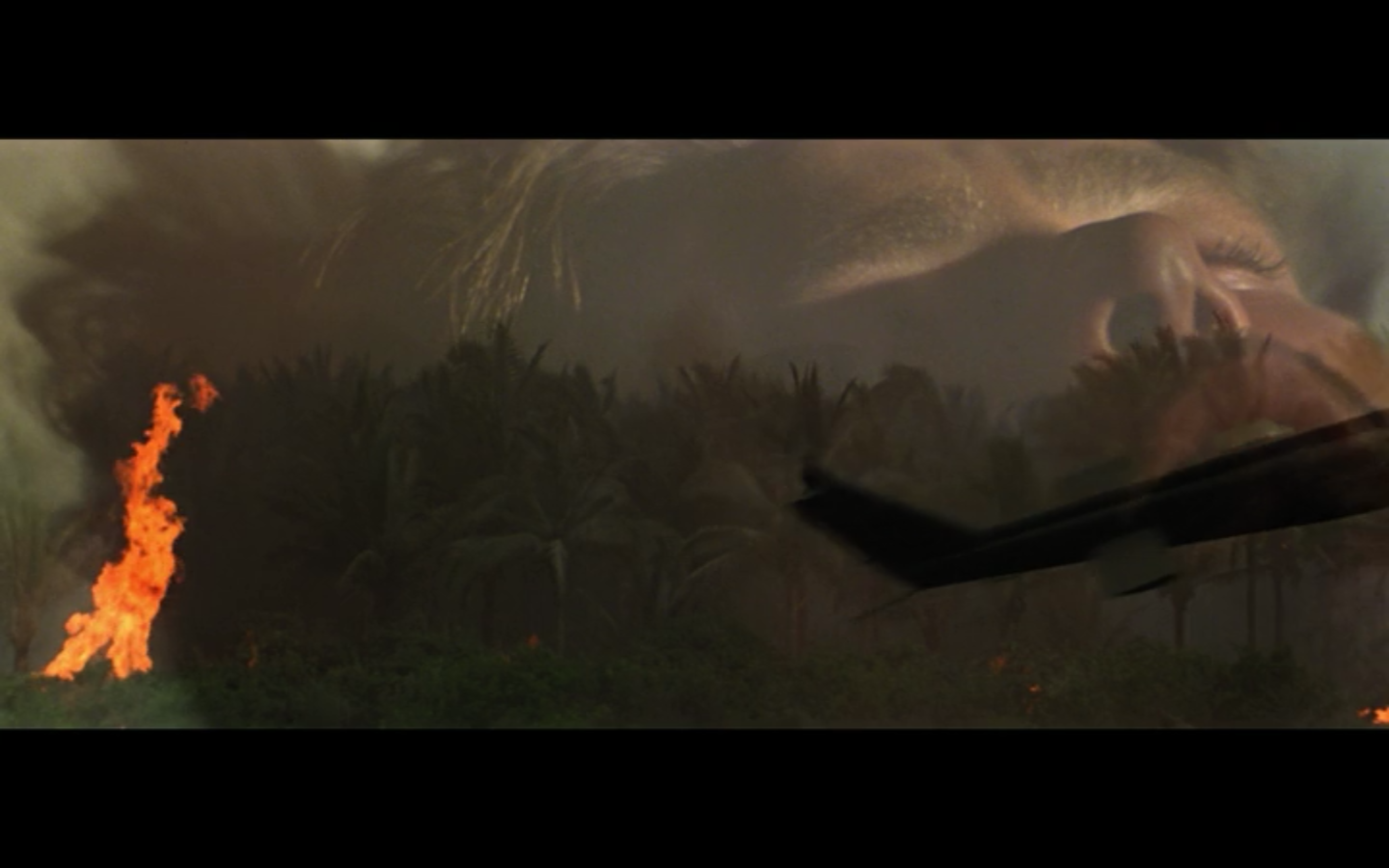
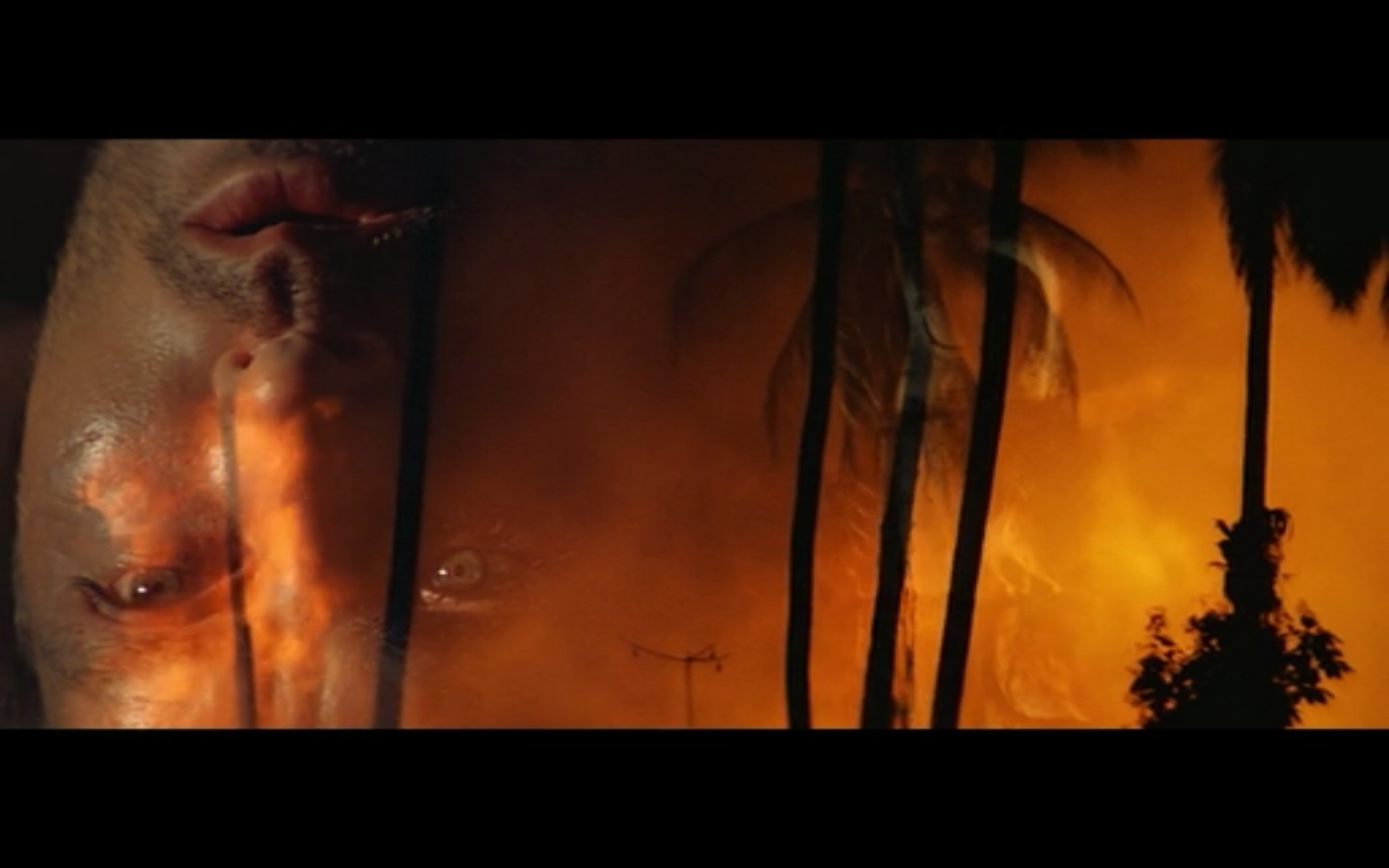
I remember the first time I saw this film and how that introductory scene sucked me in instantly. The first faint, ominous sound of the distant helicopter, perennially presaging slaughter, as we will soon realize. (My first synth, an old Roland D-50, contained just that sound and called it, yes, “Apocalypse Now.”) Willard’s mind, lost, roaming feverishly in the jungle. Morrison’s pitiless voice, singing goodbye to his beautiful friend.

Screen shot 2012-12-17 at 1.03.50 AM

I love films that promise an open-ended journey of some kind, where the world keeps expanding along the way, becoming ever stranger and more intricate. Vast, and then vaster. That’s partly why I prefer the first of the Lord of the Rings films, before the battles really take over. That sense of warm, comfortable, self-contained Hobbiton slowly opening out into the farther reaches of the Shire. Those first disturbing brushes with the ring-wraiths, and then … Bree, the world of Men.

And then … the big country – approach of mountains, realm of elven sacred space, dwarf-land deep in the earth, wilder and more unpredictable terrain, and finally … we reach the Great River, bordering, essentially, the end of the world. The final chilling scene of Frodo and Sam on the mountain, gazing out at that end, that terrifying unknown, and knowing it is their destination to enter its very heart.

After a bunch of weeks with no time for movies, I’ve been able to fit some in recently, and oddly even this one has a scene echoing that experience, although on a far smaller scale of course.

Screen shot 2012-12-25 at 5.23.15 AM

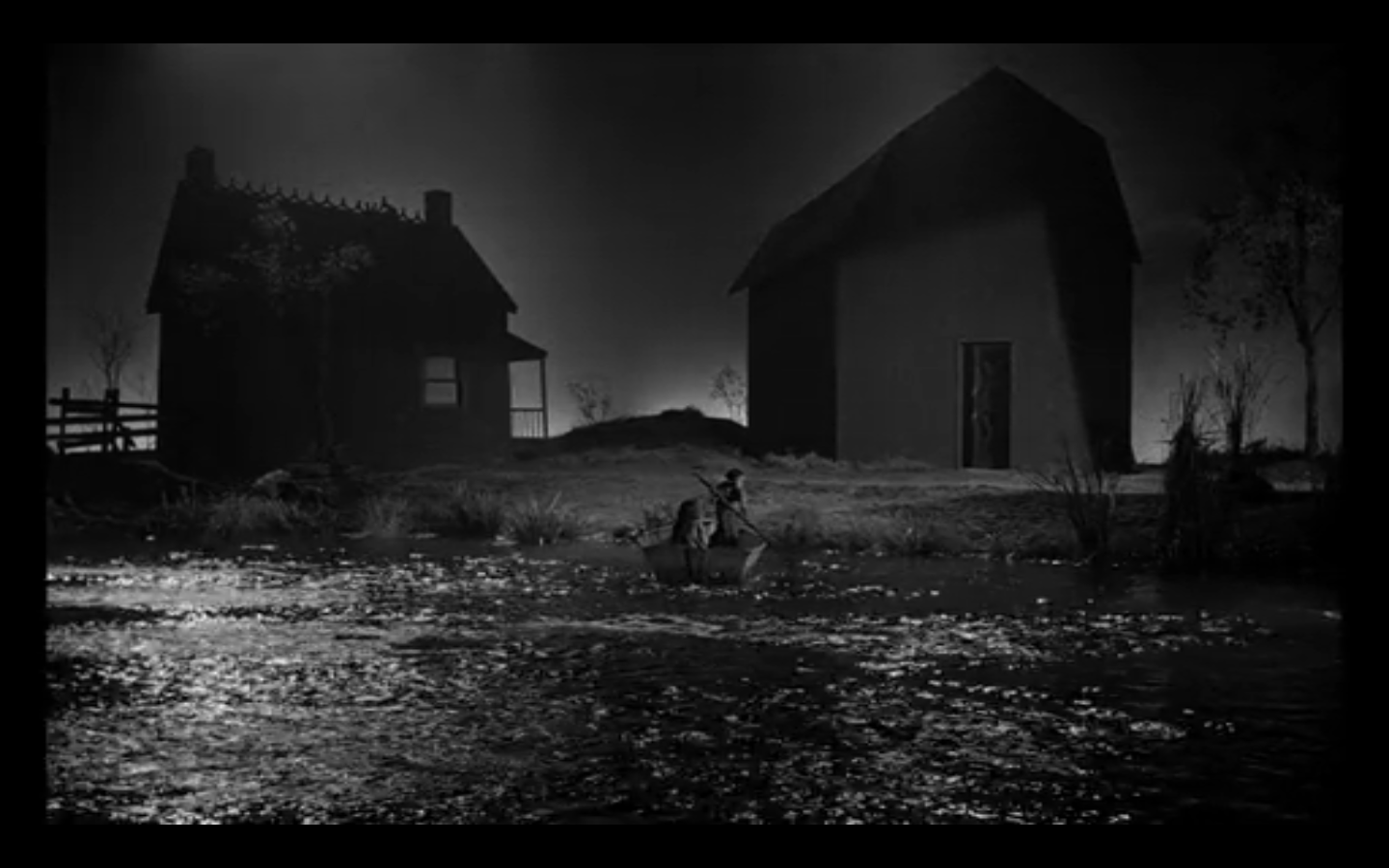
The previous time I’d seen The Night of the Hunter I’d been distracted by some of the melodramatic aspects and the at times cheesy 1950s-style acting. This time though I was able to let enough of that go to focus on the film’s mythological quality.

I don’t mean “good vs. evil” so much, or even “the story of love and hate” (told by the utterly deranged and murderous “preacher,” played by Robert Mitchum, with the help of his knuckles). Rather, I think the movie is trying, in part anyway, to evoke the experience of “innocence” somehow, reaching towards some sense of it. It’s the lengthy river scene that most points in this direction. There is no dialogue – just the famous expressionist cinematography carrying the two children … where? They have no idea, no destination. They have suddenly entered a strange, enormous, uninhabited world of earth and sky and stars, with no map and no plan. They only know that forward is the only way to go.

Screen shot 2012-12-25 at 5.21.44 AM

Rivers so often function this way in stories, as the borderland between safety and danger, known and unknown. The depths of the jungle where Kurtz rules, too, is another world — no ordinary civilization holds sway there. And the eerie, mirage-like river journey that takes us there has a spiritual quality. An old track from the Aloof samples it (and the great lama Trungpa Rinpoche said much the same thing): “Never get out of the boat. Absolutely goddamn right. Unless you were going all the way.”

Screen shot 2012-12-17 at 1.03.14 AM